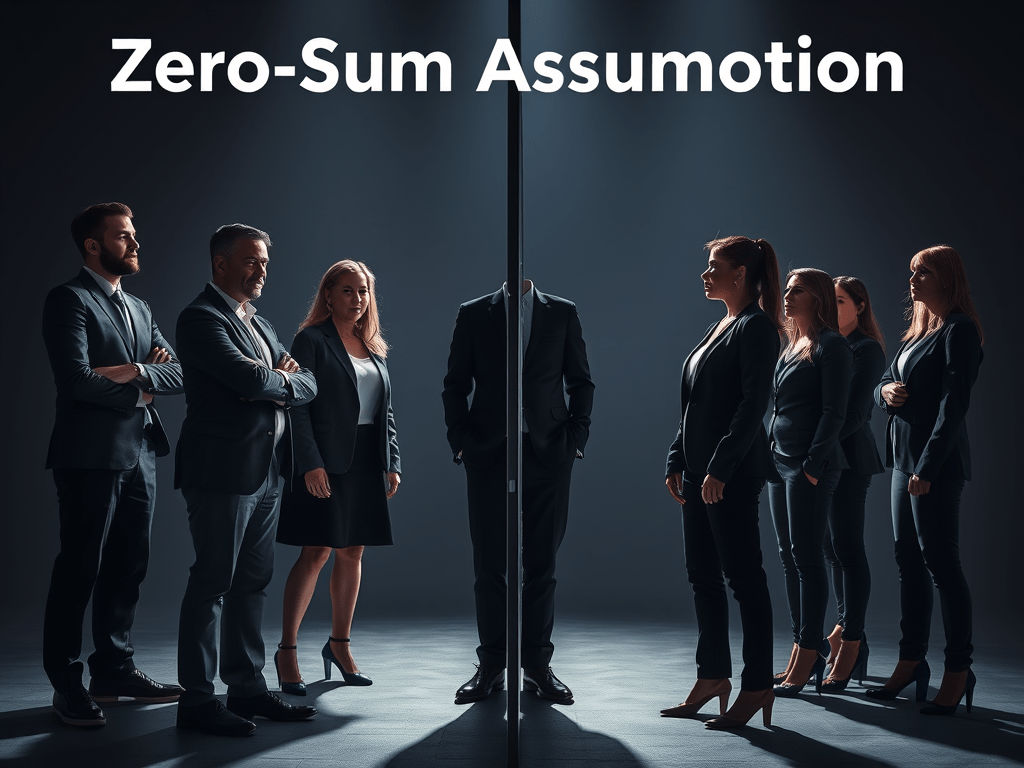
The Winner Takes All
👭Success is limited. Members work in silos
Category: Zero-Sum Assumptions
Sample situation:
A project team becomes inwardly competitive, withholding information from each other in the belief that recognition, funding, or leadership credit will only go to one person. Though the mission is shared, members begin working in silos, subtly undermining others and protecting their own “wins.”
Mental model:
“Success is limited; for me to succeed, others must lose.”
Self-discipline:
Name and challenge the zero-sum belief. Practice shifting from competitive framing to mutual purpose and interdependence. Otherwise we risk the collapse of the system.
Developmental Responses Across the Lineage:
| Developmental Stage | Interpretation & Limit |
|---|---|
| 1. Plato & Kant | Interpreted as a distortion of reason and justice — a false projection from a fear-driven perception. Limited in offering tools for transforming such thinking in daily practice. |
| 2. Craik & Cognitive Science | Seen as an internal model shaped by earlier life or social conditioning. Cognitive science may reveal its predictive logic but lacks direct moral challenge or reframing mechanisms. |
| 3. Argyris & Schön | Interpreted as a “governing variable” driving defensive reasoning and single-loop behavior. Double-loop learning would target the root assumption: “Only one can win.” |
| 4. Senge & The Fifth Discipline | Framed as a systemic breakdown (escalation archetype is entrenched and reinforcing) in team learning and shared vision. Tools like the Ladder of Inference and Left-Hand Column would help uncover and reframe the belief. |
| 5. Isaacs, Bohm, Schwarz | The belief would show up as an “undiscussable” that fractures dialogue. Collective suspension of assumptions through dialogue would help reveal interdependence and shared aims. |
| 6. Coaching & Personal Transformation | Revealed as a competing commitment — e.g., desire to contribute vs. fear of invisibility. Transformation happens by surfacing emotional roots and expanding identity frames. |
| 7. Present Moment (AI, Global, Ecological) | Interpreted as a product of scarcity-based systems (economic, political). Requires a narrative shift — toward regenerative logic, abundance mindset, and shared authorship. |
 Systems Thinking Research & Leadership Development Institute (STRLDi)
Leave a comment