BATSWANA HAVE THE WORST
WORK ETHIC IN THE WORLD – REPORT
In its 2015 survey of African workers, South Africa’s Rand Merchant Bank found Batswana to be the laziest on the continent. The problem is actually more acute than that.
In the 2017-2018 Global Competitiveness Report, Botswana scores the worst among the 137 countries that are tracked by the World Economic Forum’s Global Competitiveness Index (GCI) on 12 pillars of economic competitiveness. From a list of 16 factors, respondents to the World Economic Forum’s Executive Opinion Survey were asked to select the five most problematic factors for doing business in their country and to rank them between 1 (most problematic) and 5. The results were then tabulated and weighted according to the ranking assigned by respondents. One of those factors is “Poor work ethic in national labour force.”
With a score of 19, Botswana’s national workforce (which would include those in the public and private sector as well as NGOs) emerge as standard bearers of the poorest work ethic in the world survey. Also doing poorly are Trinidad & Tobago (15.9), Brunei (14.4), Sri Lanka (11.1), Liberia (10.8), Bhutan (10.5), Seychelles (10.1), Malta (9.8), Georgia (9.7), Mauritius and Vietnam (9.5), Namibia (9.3), Bahrain (9.0), Kuwait (8.7) and United Arab Emirates and Jamaica (8.6).
WEF’s interest in labour productivity has to do with the fact that it impacts on business. A University of Botswana study by Professor John Makgala and Dr. Phenyo Thebe (“There is no Hurry in Botswana”: Scholarship and Stereotypes on “African time” Syndrome in Botswana, 1895-2011”) found that this lack of productivity has frustrated effort to attract foreign direct investment. Interestingly, there was a time when, according to literature that the authors quote, Botswana’s civil service “was generally believed to be the most efficient in the whole of the African continent.”
On a past trip to Singapore, former and late President Sir Ketumile Masire gained an appreciation on the efficiency of the country’s workers. Where a Motswana factory worker would produce one shirt within a given period of time, a Singaporean counterpart would produce six within the same period.
“This was productivity not in theory but in demonstrable terms. When we say we are not productive, this is what we meant,” Masire recalled to Sunday Standard in 2015 of this experience which would lead to Botswana benchmarking with Singapore and delegations from the two countries travelling back and forth.
As one of the Four Asian Tigers, Singapore would provide one quarter of the inspiration to establish the Botswana National Productivity Centre (BNPC). The tigers are Hong Kong, Singapore, South Korea, and Taiwan. Along the way, however, the late president appears to have given up on ever inculcating the right work ethic in Batswana. On assessing the apparent resistance, he determined that Batswana’s poor work ethic was a result of their pastoralism.
“If you look at the life of pastoralists, they don’t have a good work ethic,” he had said. The example he had cited was that beyond sinking a borehole for their livestock, letting out cattle to pasture and doing some other undemanding work, most of the time pastoralists are just lazing about as their cattle graze untended in the bush. By Masire’s analysis, this is the work ethic that has been bequeathed to modern-day Botswana.
As a University of Botswana study shows, not one productivity intervention scheme by the government has produced the desired results. In his 2015/16 budget speech, the Minister of Finance and Economic Development, Kenneth Matambo, lamented the low levels of labour productivity in Botswana. The best performers in terms of work ethic in the national labor force are from Zimbabwe and Venezuela underpinned by a perfect score.
Source: Sunday Standard. http://www.sundaystandard.info/batswana-have-worst-work-ethic-world-%E2%80%93-report Retrieved May 23, 2018
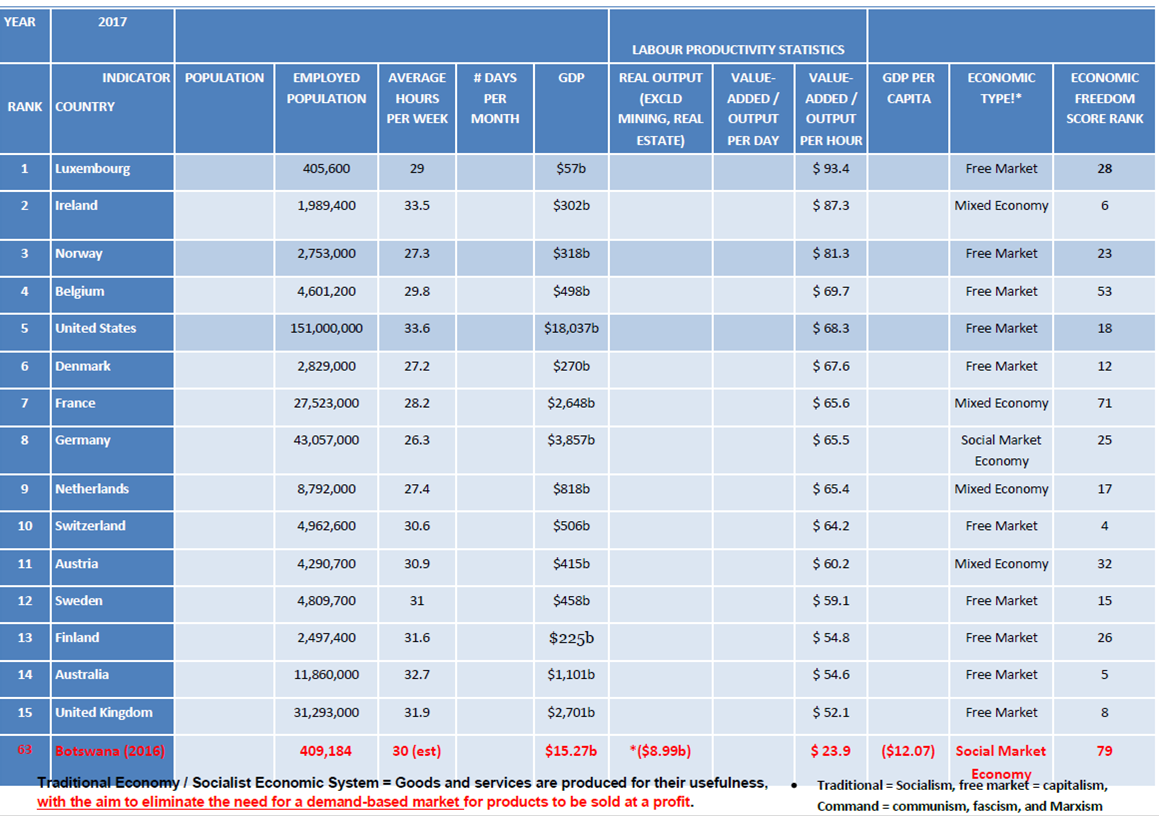
Table 1: Comparison of Botswana with 2017’s Best Global Labour Productivity Data
DID YOU KNOW? THE AVERAGE PER CAPITA PRODUCTIVITY IN BOTSWANA
LAGS THE WORLD’S PRODUCTIVE COUNTRY BY 30-40 TIMES?
TALKING POINTS:
COUNTRY’S GENERAL ECONOMIC PRACTICE:
An economic system defines the mechanism of production, distribution, and allocation of goods, services, and resources. It operates in a society or country with defined rules and policies about ownership. There are also policies about administration.
The most commonly followed economic system is modern-day capitalism. It was developed from a framework. This framework aimed to secure the supply of key elements required for industry. These elements include land, machinery, and labor. A disruption in any of these would lead to increased risk and loss for the venture.
THE COUNTRY’S GENERAL ECONOMIC PRACTICE, ON THE OTHER HAND:
Socialists viewed this commoditization of labor as an inhuman practice. I believe those words are distinctively from the female voice. This stems from Marx’s known instances of showing great sympathy for peasants. He also showed great sympathy for women as important forces for change within Marx’s theory. It marks the genesis of a matriarchal society. Women often lead quietly from behind the scenes as a response to survive in the face of absent males. These males have needed to travel long distances. They work in the agriculture and mining industries. As a result, women left to fend on their own have become increasingly ‘masculinized’.
These, I believe, led to the birth of Karl Marx’s idealism on socialism and socialist economies across a few countries.
- How does a socialist economy work?
- The starting point to this form of economy is typically three-fold:
- The country has considerable access to wealth generated by mining underground mineral and fossil fuel resources, which is demanded by other world economies and is traded in exchange for income;
- Or it has traditionally enjoyed a monarchy and/or a pastoral economy. It has access to substantive land spaces. This allows it to multiply livestock and warm crops. These crops do not need as much attention compared to cold crops. The rates are faster than the rate at which the human population multiplies with relative ease. The monarchy supports its people when they ask for help. It helps distribute the wealth as shared resources like land. It also provides meat and food as needed.
- Either way, the population has a tradition and work ethic that differ from farmers in parts of Asia. In southern China, for example, rice cultivation can be intricate, laborious, and multi-seasonal within a year. The majority have limited resources. They have learned to improve the returns on their labor by becoming smarter and more collaborative. They achieve this by managing their time better and making better choices. In other words, more than simply working hard, they worked intelligently and strategically. Cultures “shaped by the tradition of wet-rice agriculture and meaningful work” produce students with fortitude. These students can “sit still long enough.” This enables them to find solutions to time-consuming and complex math problems, for instance. As such, hard work, given this context, can easily be seen as more difficult than usual. It can, hence, be regarded as inhumane. Source: “Rice Paddies and Math Tests,” Malcolm Gladwell.
- The country has considerable access to wealth generated by mining underground mineral and fossil fuel resources, which is demanded by other world economies and is traded in exchange for income;
THE RESULTANT REALITY OF THE ECONOMIC PRACTICE:
Botswana’s real labour productivity per capita is USD 2. It measures the employed population’s output, excluding value added by mining and real-estate sectors. This is measured against the total population of the country for a truer reflection of real per capita income. USD 2.2 per hour or USD 18 per day, and that is, before deducting costs of operations. Luxembourg sets the pace as the global labour productivity leader at USD 93.4 per hour or USD 747 per day (or USD 16,437 per month). At this rate, Botswana’s productivity (and therefore wealth) lags (falls behind by) at 30-40x behind that of Luxembourg.
It makes one wonder. In our efforts to avoid capitalism and obvious inhuman labour practices, at what cost have we done so? We strive for wealth accumulation and perfect equality in income distribution. Will our efforts to transform the manufacturing and industrialization sectors succeed? Can our efforts to diversify the economy, moving from the tried and tested, gain traction? We need to understand the underlying forces that detract us from such efforts.
The Question is:
- Would we rather continue this way as if business is usual?
- How much would we drag a burgeoning burden on the state in the process?
- What will be the end state of that burden on the government and the country?
Gaining such understanding in our minds would mean gaining the power in our hands. If you can imagine it, then you can create it.
STEPS GOING AHEAD:
However, this approach risks deterring organizations from capitalist economies from engaging with or investing in such an economic system. These institutions have built their wealth through performance-based merit. They demonstrate resilience over time and operate within clearly defined standards. Their income and wealth growth have been consistent, driven by a disciplined focus on reducing production costs and improving efficiency. This approach not only strengthens individual enterprises but also contributes meaningfully to broader economic growth.
Interestingly, no pure socialist, capitalist, or communist economy exists in the world today. All economic system changes were introduced with a big bang approach. They had to make “adjustments” to allow appropriate modifications as the situation developed.
Over time, most state-run subsidy systems that lack high productivity standards become unsustainable in supporting expansive social programs. Despite receiving significant external aid, poverty levels often stay high. This dynamic worsens income inequality. It deepens the divide between the wealthy and the poor. It places an overwhelming and unsustainable burden on public welfare systems.
Reform efforts often aim to transition toward a mixed economy that incorporates free-market mechanisms. This involves reducing government control over small enterprises and phasing out redundant positions within the state workforce. Such measures are put in place to facilitate self-employment. They allow a significant portion—potentially up to 40%—of government employees to transition into the private sector. This structural shift lays the groundwork for a broader income tax base. It fosters greater fiscal self-reliance. It also reduces long-term dependency on state support.
In the short term, to alleviate economic pressure, policymakers will prioritize attracting increased foreign investment. This often involves the establishment of tax-free special development zones. These zones enable foreign companies to operate with minimal restrictions. They allow for the repatriation of profits without tariffs. These measures represent a departure from traditional centrally planned, socialist economic models. However, they are not a substitute for comprehensive structural reform. Relying solely on these mechanisms risks undermining long-term economic stability and self-sufficiency.
Fundamental change requires substantive reform—even when directed at a nation’s own citizens. These reforms must establish a clear link between wages and individual productivity. They should avoid relying on rank, seniority, or attendance as the basis for compensation. Without this shift, efforts toward transformation will remain partial and ineffective. For true and lasting change, citizens must understand their productivity’s direct impact. It contributes to both national prosperity and personal income. This awareness is essential for driving accountability, performance, and sustainable economic development.
THE BOTTOM LINE
Socialist economies across the globe have existed and continue to progress. However, there may not be any standard pure socialist economy remaining. Timely and fundamental shifts in programs and policies have allowed such economies to thrive. China is the world leader among them. The ones taking a rigid stand are facing severe problems or developing parallel markets.
Source: Socialist Economies: How China, Cuba And North Korea Work | Investopedia https://www.investopedia.com/articles/investing/081514/socialist-economies-how-china-cuba-and-north-korea-work.asp#ixzz5GKkjPmXQ
Follow us: Investopedia on Facebook
Underlying Mental Models and Beliefs that perpetuate low productivity as outlined in this post.
This blog post is titled “When the Economy Speaks: Cracking the Botswana Productivity Code – Short Notes Part II”. It explores the systemic and cultural factors. These factors contribute to Botswana’s persistent productivity challenges. Drawing from systems thinking principles, the article identifies several underlying mental models and beliefs that perpetuate low productivity.
1. Short-Termism and Preference for Immediate Gains
There is a prevalent focus on achieving quick, visible results rather than investing in long-term, foundational improvements. This mindset leads to prioritizing short-term projects that offer immediate benefits. But it often sacrifices sustainable growth and systemic change. Such an approach can result in recurring issues as underlying problems stay unaddressed.
2. Equating Compensation with Rank and Tenure
A common belief equates higher compensation with seniority or rank and, hence, attendance rather than actual productivity or performance. This perspective discourages merit-based incentives. It can lead to complacency. Employees do not feel motivated to improve efficiency or innovate if rewards are not tied to performance.
3. Perception of Government as Primary Provider
There exists a widespread expectation that the government is the main source of employment and economic support. This belief can stifle entrepreneurial initiatives. It can also reduce individual accountability. Citizens rely heavily on state provisions rather than seeking self-driven economic opportunities.
4. Resistance to Change and Innovation
Cultural norms that value tradition and established practices can lead to resistance against new approaches or technologies. This reluctance to embrace change hampers the adoption of innovative practices that enhance productivity and economic diversification.
5. Limited Emphasis on Systems Thinking
A lack of systems thinking in policy and organizational decision-making leads to fragmented approaches to problem-solving. Interventions need a holistic understanding of how different components of the economy interact. Otherwise, they tackle symptoms rather than root causes. This results in ineffective solutions.
6. Underinvestment in Human Capital Development
There is insufficient emphasis on developing skills and competencies that align with the evolving demands of the global economy. This gap in human capital investment limits the workforce’s ability to adapt to new technologies. It also constrains productivity growth by hindering adaptation to new processes.
7. Over-reliance on External Aid and Resources
Dependence on foreign aid and external resources can create a false sense of security. This reduces the urgency to develop internal capacities. It also delays the creation of self-sustaining economic strategies. This reliance also leads to policy decisions that prioritize donor preferences over local needs and contexts.
Addressing these deeply ingrained beliefs and mental models requires a concerted effort. We need to shift mindsets toward valuing long-term planning, merit-based systems, innovation, and self-reliance. Integrating systems thinking into education, policy-making, and organizational practices can help offer a more holistic approach. This integration leads to a sustainable way to improve productivity in Botswana.
REQUIRED RESEARCH ANALYSIS
FOR DETAILS OF DATA REQUIRED FOR RESEARCH ANALYSIS FOR THIS TOPIC, CLICK HERE.
FOR THE FULL STORY, CLICK HERE.
 Systems Thinking Research & Leadership Development Institute (STRLDi)
Leave a comment