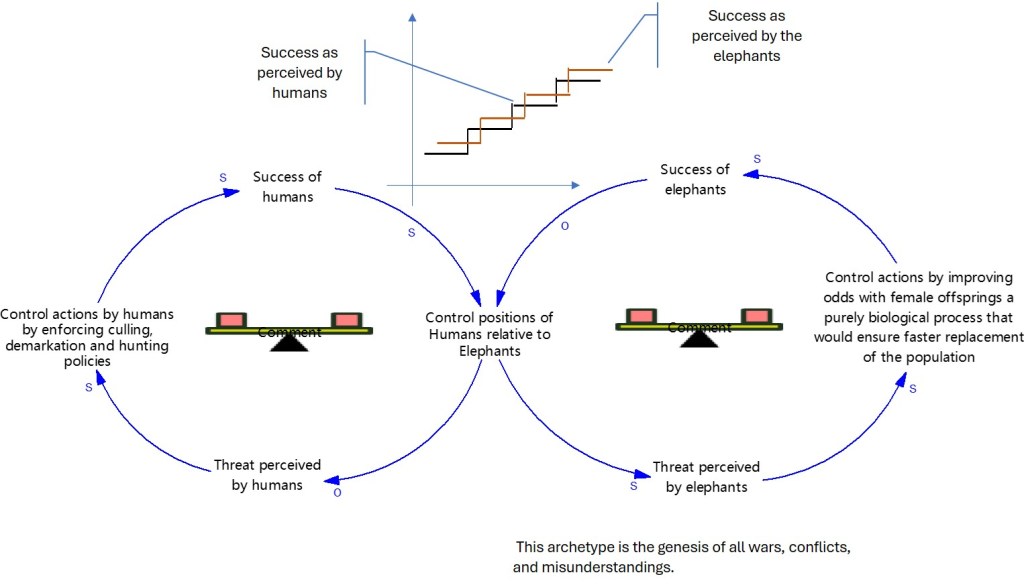
A Case Study of the Escalation Archetype
(STRLDi System Archetype Compendium)
It becomes the ecological counterpoint to Not Enough Manpower: both are systems in which over-exertion of the masculine (control, conquest, protection) calls forth the balancing feminine (nurture, restoration, renewal).
🪞 Leadership Mirror
When we protect too hard, nature learns to protect from us.
Every system defends what it loves most.
In the rush to preserve crops, livelihoods, and human safety, we armed ourselves with fences, firearms, and fear.
In doing so, we taught the elephant that its own safety also lies in defence.
Two intelligences, each acting rationally for survival, spiral into conflict — until one learns restraint.
The test of leadership here is not dominance, but the courage to de-escalate.
🌍 Before You Read
Between 1980 and 2020, southern Africa’s savannas became a stage for a quiet, decades-long contest between expansionist humans and displaced elephants.
As villages, farms, and roads expanded, elephants found their ancient migratory corridors severed.
Retaliatory killings rose; so did public anger.
Each season, villagers asked for stronger measures — better fences, faster response teams, even the return of trophy hunting.
This is the story of how an intelligent species, capable of grief and memory, began to change its behaviour long before policy caught up.
It is also the story of how a nation misread that adaptation as “over-population.”
The pattern is the Escalation Archetype written across the land.
📆 Events
Crop raids in the Okavango and Chobe districts.
Villagers injured or killed defending fields.
Elephants shot in reprisal.
Each act justified as “protection.”
By the early 2000s, conflict reports had doubled within a decade.
Public sentiment hardened: “There are too many elephants.”
Both sides now trapped in a reinforcing loop where every act of defence fuels the next.
📈 Patterns
Across time, incidents follow a jagged rhythm—peaking in drought years, easing in wet ones.
By the mid-2010s, telemetry data revealed a shift:
elephants walking at night, lengthening routes, avoiding settlements entirely.
This was not a change of diet or curiosity;
it was memory re-engineering itself—a species learning how not to re-enter pain.
Nature, not government, was the first to attempt de-escalation.
🔍 Data Reflection – Poaching Trends (Insert here)
📊 Historical Pattern – Hunting, Culling, and Policy Feedback (Insert here)
Data Reflection
Throughout the 1970s and 1980s, elephant populations across sub-Saharan Africa declined sharply under commercial poaching for ivory. By 1989, when the CITES ivory trade ban took effect, the killing rate in parts of East and Central Africa exceeded natural birth rates.
Botswana and neighbouring states responded with intensified patrols and, later, community-based conservancies. From 2003 to 2011, the MIKE/PIKE index (Monitoring Illegal Killing of Elephants / Proportion of Illegally Killed Elephants) rose again, peaking around 2011.
Since 2015 the trend has reversed: continental poaching mortality has fallen by more than 50 percent, reaching its lowest level since monitoring began in 2003.
In Botswana, official carcass counts dropped from roughly 400 per year (2014) to fewer than 100 (2022).
What looked like a population “boom” after the hunting ban thus coincided with the first sustained decline in poaching pressure in decades — the system finally exhaling after half a century of chronic stress.
⚙️ Structure
At the heart of the conflict lies a pure Escalation Loop:
Human protection → Elephant resistance → Heightened fear → More protection → More resistance.
⚙️ Structure Commentary
Every defensive act by one side — meant as a balancing move — is read by the other as aggression.
When left unseen, these two opposing balancing loops interlock into a single reinforcing cycle.
Each side’s “reasonable reaction” fuels the other’s escalation until the loop acquires a life of its own.
Once triggered, it does not stop until at least one party sees the structure for what it is.
If neither does, the pattern hardens into the roots of inter-generational conflict, wars, and even gender struggles — all versions of the same reflex.
The only real antidote is swift recognition: spot the loop before it starts and, yes, swallow the pride long enough to let wisdom take the lead.
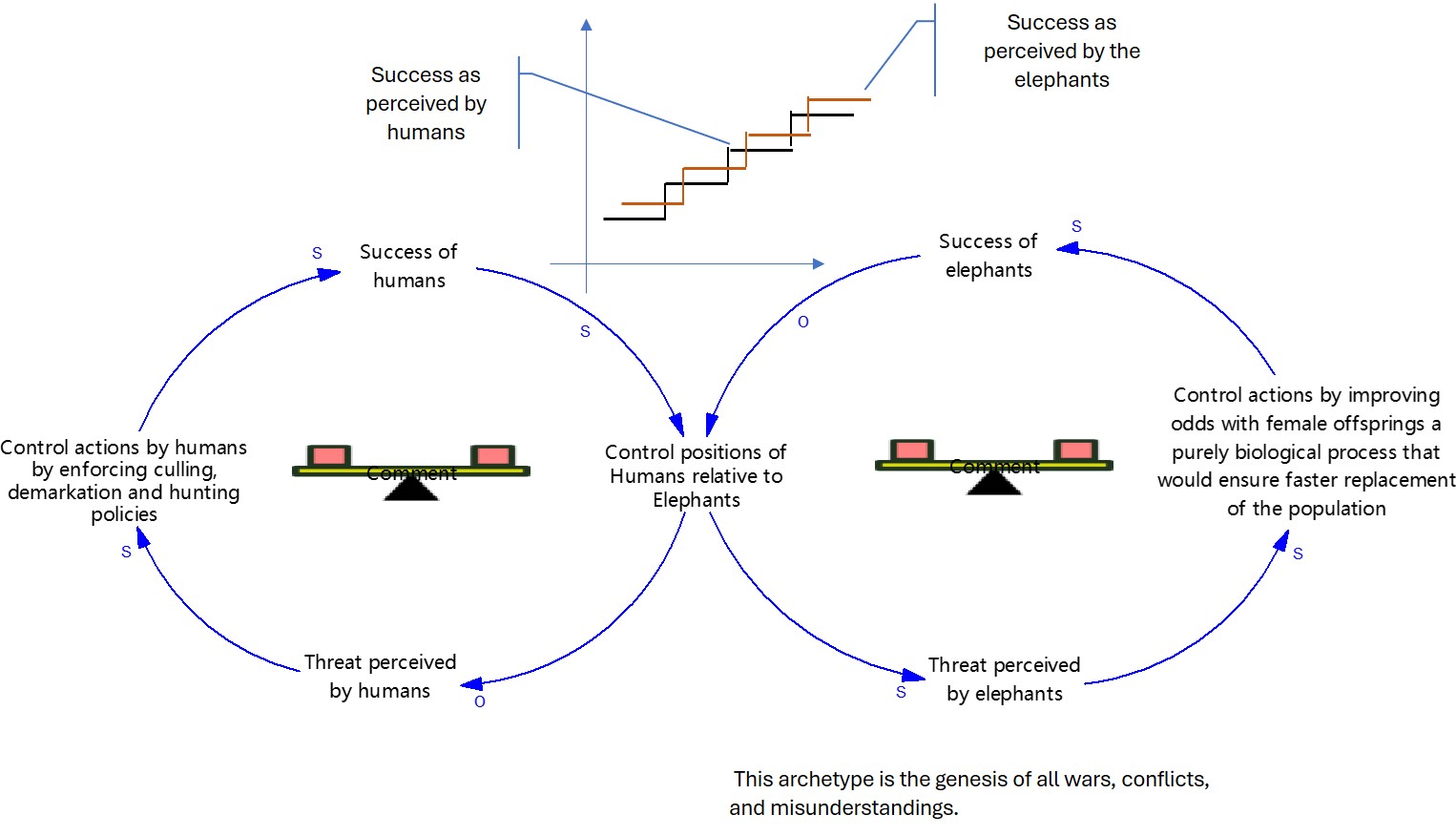
This loop did not exist in nature; it began when humans settled on elephant land, crossing an ecological boundary quietly respected for millennia.
⚙️ The Systemic Logic
Disturbance or Loss Event (Population Shock)
War, culling, or poaching disproportionately removes mature males (and sometimes breeding-age females).
This sudden skew in the adult population triggers both social stress and a biological correction drive in remaining males.
Behavioural Response (Reinforcing Reflex)
Males increase mating frequency and range.
In humans, post-conflict societies often show a surge in birth rates — an intuitive “replacement reflex.”
In elephants, surviving bulls enter prolonged musth or seek multiple receptive females; reproductive intensity rises.
Physiological Feedback
Frequent copulation and shortened abstinence intervals reduce overall sperm motility and Y-chromosome viability (Y-carrying sperm are smaller and faster but die sooner).
Over time, conceptions tilt toward X-carrying (female) sperm fertilisations — a biological balancing loop compensating for male loss.
Population-Level Outcome (Balancing Correction)
The system restores sex-ratio stability by generating more females, rebuilding the reproductive base before competition among males increases again.
When equilibrium returns (male numbers normalise, stress eases, sexual competition declines), sex ratios revert toward 1 : 1.
System Archetype Framing
This is a a Balancing Restoration Loop: Male mortality or stress → high mating frequency → reduced Y viability → more female births → restored reproductive base → decreased mating pressure → parity returns.
🌿 Why It’s Important for Our Human–Wildlife Conflict Study
- Elephants under anthropogenic stress (poaching, translocation, drought) and humans under social stress (conflict, famine, instability) may exhibit the same systemic correction mechanism.
- The apparent “increase in female births” is not random — it’s the system seeking stability.
- Therefore, conservation and policy interventions that misread this as “healthy fecundity” risk reinforcing instability; the real signal is stress recovery at work.
🔬 Testable Hypotheses for The Next Case Study
| Hypothesis | Test Variable | Expected Signature |
|---|---|---|
| H₁: Male loss → higher female births | Adult male mortality vs. calf sex ratio (lag = 2–3 years) | Negative correlation |
| H₂: High mating frequency reduces Y viability | Male hormonal/stress markers vs. offspring sex ratio | Elevated cortisol → female-bias |
| H₃: Stabilised social structure restores parity | Herd stability index vs. birth ratio | Stable hierarchy → 1 : 1 parity |
🧠 Mental Models
Humans: “Nature must be controlled to secure safety.”
Elephants: “Humans bring pain—avoid them.”
Each side’s fear mirrors the other’s conviction.
Both act rationally within their view; both sustain the loop.
🎯 Leverage
According to Law #8 – Small changes produce big results, leverage lies not in stronger control but in how information is read.
Migration data, herd spacing, birth ratios — these are not statistics but messages from the ecosystem.
Leadership begins when we interpret feedback as dialogue, not evidence for more force.
🌅 Bridge to the Future
When elephants began walking further, moving at night, and reducing encounters, they were not merely adapting routes.
They were choosing not to re-trigger the archetype.
For a species whose memories are inherited across generations, such change signals a profound act of learning.
Healing did not come from patrols or policies—it came from silence and distance, from refusing to continue the pattern.
To heal a system, nature teaches, is to not let the loop restart in the first place.
🌿 Future Reality Vision
A harmonious future will not arise from “better management,” but from remembering where not to build, not to farm, not to dominate.
Elephants move freely through ancestral corridors; humans read those movements as ecological intelligence, not nuisance.
Conflict rates fall not from enforcement, but from a shared remembrance of boundaries once honoured.
💫 The Elephant Wearing the Uncle’s Hat
Only here does the metaphor belong.
The elephant did not retaliate, legislate, or negotiate.
By stepping back, it allowed both species to live.
This restraint—refusing to re-enter an old reflex—is the highest form of systemic leadership.
It is what human managers and policymakers must learn when confronting persistent problems:
to see where engagement perpetuates the wound, and where healing begins with silence.
The narrative above outlines one such systems reading. Yet its completeness depends on evidence we do not yet have: community-level birth and gender ratios, historical quota records, and migratory data from different districts. We therefore invite demographers, conservation scientists, and investigative journalists to test these hypotheses within their own spheres of influence.
🪶 A Mirror Across Species — When Systems Over-Extend the Masculine
Historical Pattern – Hunting, Culling, and Policy Feedback
A Mirror Across Species — When Systems Over-Extend the Masculine
The same structural rhythm that drives elephant populations under stress also appears quietly in human societies.
In polygynous families, where one male stretches his reproductive energy across multiple concurrent unions, the body responds with a compensating reflex: over time, births lean female.
⚙️ 1. The Structure Behind Polygamy
Polygamy (usually polygyny – one male, multiple females) creates a reinforcing loop of male scarcity and reproductive concentration:
| Variable | Tendency | Systemic Effect |
|---|---|---|
| Number of breeding males | ↓ | Reproductive power concentrates in a few males |
| Number of conceptions per male | ↑ | Higher mating frequency, shorter intervals, reduced sperm rest |
| Physiological stress on sire | ↑ | Elevated cortisol, lowered testosterone-to-cortisol ratio |
| Viability of Y-bearing sperm | ↓ | Gradual tilt toward X-bearing (female) conceptions |
| Offspring sex ratio | → Female-biased over time | |
| Long-run population balance | → More potential mothers → system self-corrects |
So, the system itself regulates the imbalance created by cultural structure.
Nature quietly “balances” what social systems distort.
It is as though the system, sensing exhaustion on one side of the loop, strengthens the regenerative base on the other.
The pattern mirrors what we see in wildlife populations exposed to hunting pressure: the more male lives are removed, the more the system responds through increased female births to preserve continuity. Both are nature’s balancing acts — not moral questions, but systemic corrections.
These six photographed families, anonymised and ordered below, show ratios ranging between 100 boys : 130–150 girls. Such visual evidence, while anecdotal, invites a disciplined investigation. Do communities organised around sustained masculine output — through warfare, labour, or multiple unions — trigger the same biological balancing reflex observed in elephant herds after decades of stress?
If so, gender becomes not a demographic statistic but a vital sign of systemic equilibrium.
Below, six anonymised family portraits (eyes blurred for privacy) illustrate this tendency:
| Family Sample | Approx. Decade / Context | Gender Distribution | Ratio (B : G) |
|---|---|---|---|
| LeBaron Family (Utah) | 1980s | 11 Boys / 15 Girls | 100 : 136 |
| Short Creek Community | 1990s | 10 Boys / 14 Girls | 100 : 140 |
| Centennial Park Family | 2000s | 9 Boys / 13 Girls | 100 : 144 |
| LeBaron Mexico Colony | 2010s | 8 Boys / 12 Girls | 100 : 150 |
| Hutterite Control (Alberta) | 1990s | 10 Boys / 10 Girls | 100 : 100 |
| Independent Family (U.S.) | 2010s | 12 Boys / 17 Girls | 100 : 142 |
Visual grid: six anonymised photos with gender bars beneath each.
Gender, viewed systemically, is not identity data—it is a vital sign of equilibrium.
For your Human–Wildlife Conflict study, this becomes a crucial parallel:
| Humans (Polygamy) | Elephants (Stress Poaching) |
|---|---|
| Many females per dominant male | Many females per surviving bull |
| High male stress, frequent mating | Extended musth, multiple matings |
| Declining Y-sperm viability | Possible female-birth tilt |
| Female-heavy juvenile population | Female-heavy herd recovery |
| Balancing nature of system | Balancing nature of ecosystem |
🪶INVITATION TO FIELD RESEARCHERS & COMMUNITY SCHOLARS – Testing Nature’s Balancing Reflex
🧬 Investigate biological vs. structural sources of skew
| Possible Driver | Mechanism | Detectable Through |
|---|---|---|
| High paternal age + frequent conception | Lower Y-sperm viability → female tilt | Birth records by father age |
| Selective retention of daughters | Social choice; sons sent away | Household censuses |
| Reporting bias in media | Editors choose “softer” images (women + children) | Sampling audit |
| Household health stress | Cortisol effect (biological) | Birth-interval data |
By differentiating these, we can test whether the skew you see is biological, cultural, or editorial.
| Field | Who Can Contribute | Potential Data or Methods |
|---|---|---|
| Human Demography | Anthropologists, demographers, community record keepers | Birth registers in plural-marriage or high-fertility populations; gender ratios by paternal interval |
| Wildlife Ecology | Elephant researchers, park authorities, conservation NGOs | Calf-gender ratios pre/post-poaching; links to hunting quotas & climate stress |
| Behavioural Biology | Reproductive endocrinologists | Cortisol/testosterone ratios vs X/Y sperm viability under stress |
| Investigative Journalism | Reporters, data-visualisation specialists | Verification of hidden demographic or ecological datasets |
Ethical note: Use anonymised or aggregate data; respect ecological and cultural privacy.
Each dataset, image, and field note is a way of listening to the system speak.
The work of balance begins when those closest to the data look again — this time through the lens of dynamic complexity.
🧭 Cross-Reference:
Previous Post: Not enough manpower
Next Post: Drought-resistant crops and extreme weather variability
Based on the Vision Deployment Matrix™ created by Dr Daniel H. Kim, first published in The Systems Thinker, Vol. 6 No. 1 (1995).
Framework adapted by STRLDi for applied national systems learning.

 Systems Thinking Research & Leadership Development Institute (STRLDi)
Leave a reply to Introducing the Compendium: Exploring The Fifth Discipline’s Impact on Leadership – Systems Thinking Research & Leadership Development Institute (STRLDi) Cancel reply