
A Case Study of the Fixes-That-Fail Archetype
(STRLDi Compendium of System Archetypes — Draft Edition)
“THE LEADERSHIP MIRROR”
Every leader believes they are solving problems.
Few notice that the problems are quietly solving them.The more effort they invest, the deeper the pattern takes hold — until exhaustion feels like purpose and urgency feels like success.
The following case is not a critique of leadership but an invitation to see leadership at work inside the system itself.
Each time we react, correct, compensate, or protect, the structure records it — and teaches.
This is the leadership mirror: a place to see our reflexes reflected back as design.
The lesson is never about who was right; it is about how the system learned from what we could not see.
Before You Read
Every bureaucracy has its rituals of rescue — the emergency meeting, the red-stamped file, the overtime marathon that proves loyalty.
For a moment, the room feels alive; the system seems responsive.
Then, just as surely, the backlog returns.
What you are about to read is not a story about slow officers or careless managers.
It is the anatomy of a reflex — a national habit of equating busyness with value.
This first study in the STRLDi System Archetype Compendium opens with a pattern called Fixes That Fail.
It asks: What if the system’s greatest crisis is its own cure?
And it invites you to see that the smallest act of awareness can transform an enterprise, a ministry, or a nation.
The Urgent Files phenomenon emerged in an investigations department charged with handling public complaints.
Its purpose was straightforward: ensure that every reported case was reviewed, investigated, and closed within prescribed time limits.
Yet, over time, the department found itself in a perpetual state of crisis.
Every few weeks management would announce a backlog-clearing exercise.
Files were stamped URGENT in red, officers were redeployed, and working hours extended.
The public applauded the temporary responsiveness, but within months the backlog returned — heavier and more demoralising than before.
When STRLDi first studied the pattern, it seemed ordinary bureaucratic fatigue.
But plotting behaviour over time revealed the familiar oscillation of the Fixes That Fail archetype:
A quick corrective action delivers short-term relief yet creates longer-term pressure that demands the same fix again.
What looked like a process problem was in fact a systemic illusion — the office was working tirelessly to reproduce the very problem it was trying to solve.
2 The Behaviour Over Time
Law #1 Today’s Problems Come from Yesterday’s Solutions
The origin of each crisis lay in the previous “solution.”
Every time the department declared an urgent-file drive, officers diverted effort from current cases to old ones.
Those current files, now unattended, quietly aged into the next batch of urgents.
The fix created its own future workload.
Law #4 Cause and Effect Are Not Close in Time and Space
The delay between setting aside a file and seeing it resurface months later disguised causality.
Managers saw only the symptom — rising complaints — never connecting it to yesterday’s rescue campaign.
Because the effect appeared far from the original action, the loop stayed invisible.
Law #2 The Harder You Push, the Harder the System Pushes Back
Each urgent drive demanded overtime and exhaustion.
For a short while output spiked, morale rose, and the public seemed satisfied.
Then the system’s “push-back” arrived: new complaints, deeper fatigue, and declining quality.
The curve resembled an erratic heartbeat — a body kept alive by stress.
Law #7 Faster Is Slower
Speed became synonymous with virtue.
Supervisors equated motion with progress.
But the faster the office moved, the less it learned.
Files rushed through without closure; decisions required re-work; coordination failed.
The department had institutionalised adrenaline.
3 The Structure Beneath the Oscillation
The causal structure was deceptively simple:
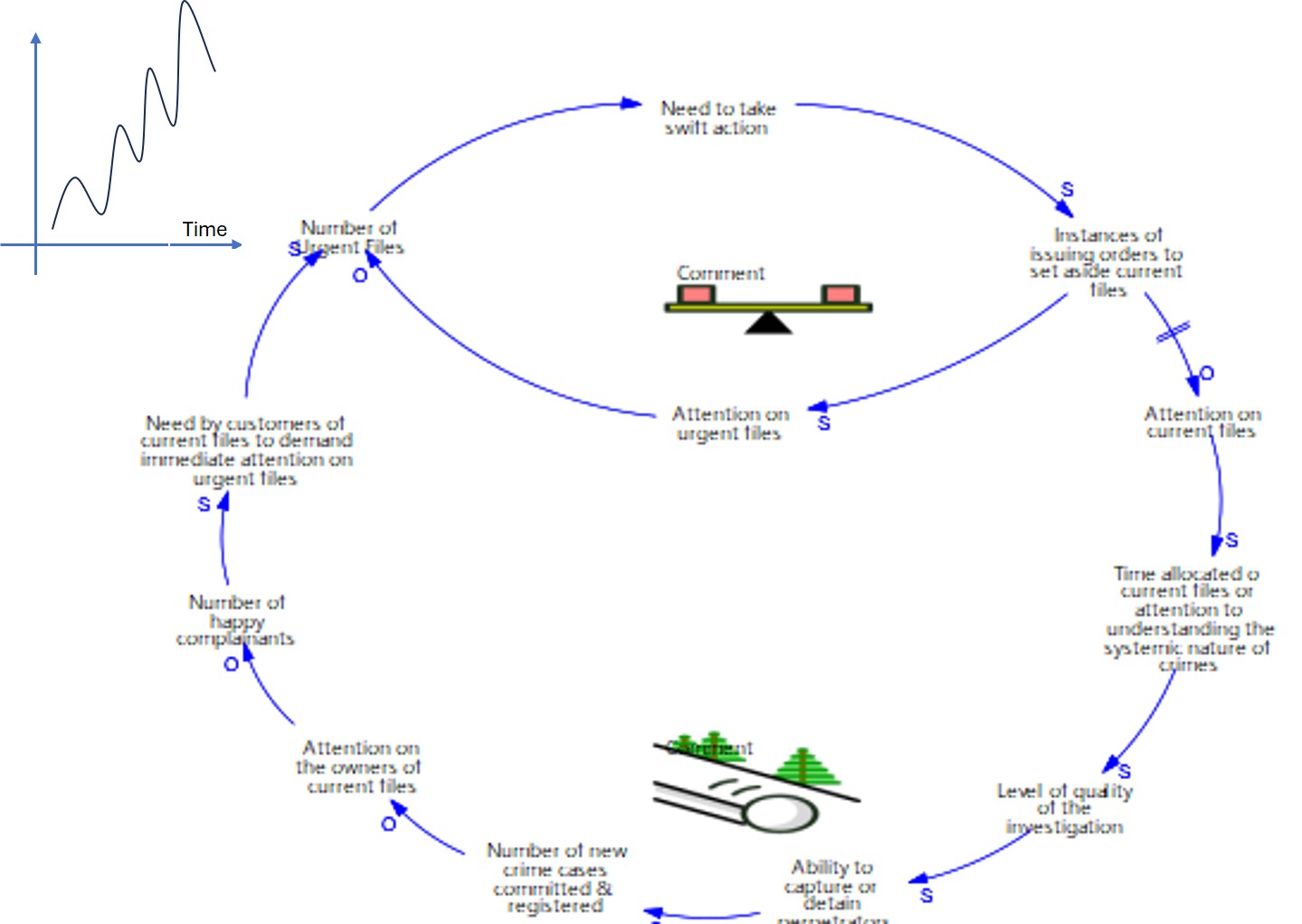
Urgent files ↑ → swift action ↑ → attention on current files ↓ → quality of work ↓ → complainant dissatisfaction ↑ → urgent files ↑
A perfect balancing loop in form — but it balanced the wrong thing: the appearance of responsiveness rather than genuine throughput.
The balancing reflex masked a deeper reinforcing dynamic of fear and pressure.
As the unseen reinforcing loop gained strength, the human reflex to “restore balance” intensified — confirming the Law of Reflexive Balance later codified by STRLDi:
Except in biological homeostasis, every balancing loop in human systems is the reflex of an unseeing system attempting to counter its own reinforcing pattern.
4 The Ladders of Fear (Mental Models)
Three ladders of inference maintained the blindness:
| Actor | Assumption | Behaviour | Hidden Fear |
|---|---|---|---|
| Supervisor | “Officers are lazy.” | Increases control and public visibility. | Fear of losing authority. |
| Officer | “Management notices only crisis.” | Waits for escalation to act. | Fear of invisibility and blame. |
| Complainant | “Government doesn’t care.” | Escalates or bypasses channels. | Fear of powerlessness. |
Each ladder reinforced the others.
Separated by hierarchy, they never met to test their assumptions.
Law #11 — There is no blame — was the missing discipline: everyone defended their role; no one saw the system.
5 The Vision That Created the Current Reality
The department still served a vision forged decades earlier: “Efficiency means rapid response.”
It wanted both speed and quality at once — the contradiction captured in Law #9, you can have your cake and eat it too, but not at once.
Performance measures rewarded volume, not learning.
The structure behaved exactly as it was designed: to appear busy.
6 The Discovery of Leverage
During a review, one senior officer — trained by experience rather than formal education — noticed something small yet profound.
Whenever he deferred a case, he called the complainant to explain the delay and outline next steps.
Those calls, barely two minutes each, eliminated most follow-up complaints.
Files no longer escalated to urgent.
The simple human act re-closed the feedback loop that the system’s procedure had severed.
Here lay Law #8 in living form:
Small changes can produce big results — the areas of highest leverage are often the least obvious.
The cost of the intervention: zero.
The impact: systemic.
No technology, no reform bill, no consultant.
Just consciousness restored at the point of disconnection.
7 The Uncle’s Act (Healing in Motion)
A wise supervisor recognised the potential but avoided formalising it.
He praised the courtesy as “professionalism” and let it spread organically.
This was the Uncle’s Act — healing inserted gently into culture:
Healing Intent: Re-humanise the flow of work.
Gentle Insertion: Allow experienced officers to model the call.
Camouflage: Present it as courtesy, not reform.
Trust Loop: Acknowledge calm complainant behaviour publicly.
Successor’s Gift: Embed it later as induction practice.
By keeping the structure unaware of its transformation, he boiled the frog without harm.
The balancing reflex quietly lost energy; the reinforcing loop of trust took over.
Balance returned as rhythm, not resistance.
8 Behaviour After Leverage
At first the curve looked wrong — urgents dropped, throughput slowed, calm felt unnatural.
But over successive cycles, quality stabilised and morale rose.
The department was living Law #3 — behaviour grows better before it grows worse.
Short-term anxiety preceded long-term healing.
Within months, urgent-file drives disappeared from the vocabulary.
Officers began competing for consistency, not crisis.
The healing reinforcing loop (call → trust → fewer urgents → time → more calls) had taken root.
9 The Future Reality Vision
In the healed system, work flows continuously instead of spasmodically.
The word “urgent” has lost its power because the system has learned to anticipate, not react.
Supervisors manage rhythm, not crisis; officers manage trust, not panic; complainants experience transparency instead of silence.
The organisation’s purpose has evolved from efficiency to reliability — from fast to steady.
Its identity is no longer built on rescue but on prevention.
This is a department that now embodies the nation’s future reality: a public service that leads not by control, but by coherence.
10 Supportive Mental Models of the Future Reality
| Role | New Mental Model | Emergent Discipline |
|---|---|---|
| Supervisor | “Flow is the new efficiency.” | Systems Thinking — seeks patterns, not incidents. |
| Officer | “I create calm when I connect early.” | Personal Mastery — pride in steady contribution. |
| Complainant (Citizen) | “My government listens even when I’m silent.” | Building Shared Vision — trust as civic culture. |
Fear has transmuted into confidence.
The belief in scarcity of time or manpower dissolves when feedback is immediate and human.
Each participant’s ladder of inference has shortened — fewer assumptions, more communication.
The walls between roles have turned into mirrors.
11 Events and Patterns in the Future System
In the healed state, the Laws of Dynamic Complexity are respected, not violated:
| Law | Expression in the Future System |
|---|---|
| #1 | Solutions are tested for side effects before implementation. |
| #2 | Pressure points are anticipated — no need to overpush. |
| #3 | Temporary discomfort is accepted as part of real learning. |
| #4 | Feedback cycles are monitored continuously — cause and effect stay linked. |
| #5 | Easy fixes are replaced by small, deliberate learning experiments. |
| #7 | Pace matches capacity; speed is calibrated, not worshipped. |
| #8 | Minor, human interventions are designed into process flow. |
| #11 | Blame has no oxygen; the conversation focuses on structure. |
The pattern now resembles a gentle rise and plateau, not a spike and crash.
It behaves like a breathing organism — self-correcting, aware of its boundaries.
The loop has evolved from Fixes That Fail to what STRLDi names a Learning Reinforcement Loop — trust reproducing trust.
12 The Future Reality
The new system functioned without drama.
Public trust steadied; workload distributed evenly; officers regained pride.
The earlier balancing loop that exhausted the system had given way to a reinforcing loop that regenerated it.
Calm was now the indicator of competence.
The “urgent” label, once a symbol of heroism, became a relic of blindness.
13 The Cost of Awareness vs. the Cost of Ignorance
A comparison later conducted by STRLDi estimated that a full business-process re-engineering of the department — consultants, workshops, IT systems — would have cost tens of millions.
The systemic leverage that achieved the same outcome cost nothing but two minutes of conversation per deferred case.
| Approach | Financial Cost | Result |
|---|---|---|
| BPR overhaul | High capital, low learning | Temporary efficiency; same pattern returns |
| Two-minute call | Negligible | Structural healing; enduring calm |
Law #8 is therefore not about efficiency; it is about economy of consciousness.
Systemic change costs awareness, not appropriations.
Every pula saved from compensating blindness becomes available for rebuilding the nation’s real capacities — agriculture, education, manufacturing — the domains that feed people, not reflexes.
14 Broader Implications — The Discipline of Seeing
The Urgent Files case demonstrates that the purpose of systems thinking is not prediction or control but seeing.
A balancing loop is not virtue; it is the reflex of an unseeing system attempting to hold still what must evolve.
Only when awareness reconnects the parts of the loop does reinforcing energy turn from vicious to virtuous.
Then, and only then, does a learning organisation begin to form.
15 Coda – From Reflex to Learning
In biological life, balance preserves being.
In human systems, balance often preserves blindness.
The Fifth Discipline teaches that learning begins the moment the reflex to “correct” gives way to curiosity to see.
The Urgent Files case is more than a story of an investigation unit; it is a mirror for governance, religion, education, and enterprise — every domain that mistakes control for care.
The smallest act of seeing together can dissolve the largest illusion of control.
That is the meaning of systemic reform.
And that is the quiet revolution already underway.
Figures
Behaviour-Over-Time – Before Leverage
Behaviour-Over-Time – After Leverage
Causal Loop Diagram – From Balancing Reflex to Healing Reinforcement
(See companion visuals: BOT_Before_Leverage_FTF.png, BOT_After_Leverage_Healing.png, CLD_Urgent_Files_FTF.png)
Summary Table of Laws Expressed in the Urgent Files System
| Law | Manifestation in Case |
|---|---|
| #1 | Each urgent drive creates tomorrow’s crisis. |
| #2 | The harder the push, the stronger the rebound. |
| #3 | Healing feels wrong before it feels right. |
| #4 | Delay hides cause and effect. |
| #5 | The easy fix leads back in. |
| #6 | The cure (urgent drives) worse than disease (delay). |
| #7 | Faster response slows real progress. |
| #8 | Smallest, least-visible act (phone call) flips the system. |
| #9 | Wanting speed and quality simultaneously creates contradiction. |
| #10 | Splitting responsibility fragments learning. |
| #11 | Seeing structure replaces blame. |
Epilogue
Law #8 — Systemic change costs awareness, not appropriations.
When a nation learns this, its ministries heal, its budgets breathe, and its people rediscover trust.
Next Post: Not Enough Manpower
Based on the Vision Deployment Matrix™ created by Dr Daniel H. Kim, first published in The Systems Thinker, Vol. 6 No. 1 (1995).
Framework adapted by STRLDi for applied national systems learning.

 Systems Thinking Research & Leadership Development Institute (STRLDi)
[…] The Urgent Files – Investigations Dept. […]
LikeLike
[…] Files multiplied because each officer, keen to prove efficiency, absorbed more than the system could learn from. […]
LikeLike