Here’s the full-length “no holds barred” post that weaves every point we’ve worked through into a single, logical flow.
I’ve structured it so it reads like a narrative of discovery—starting from the Zambia–Botswana trade question, unfolding into the systemic insight on shared production planning, and ending with a compelling call for regional transformation.
From Zambia–Botswana Trade Gaps to a Vision for Shared Production in Southern Africa
It started as a simple question:
Why isn’t trade between Zambia and Botswana already higher?
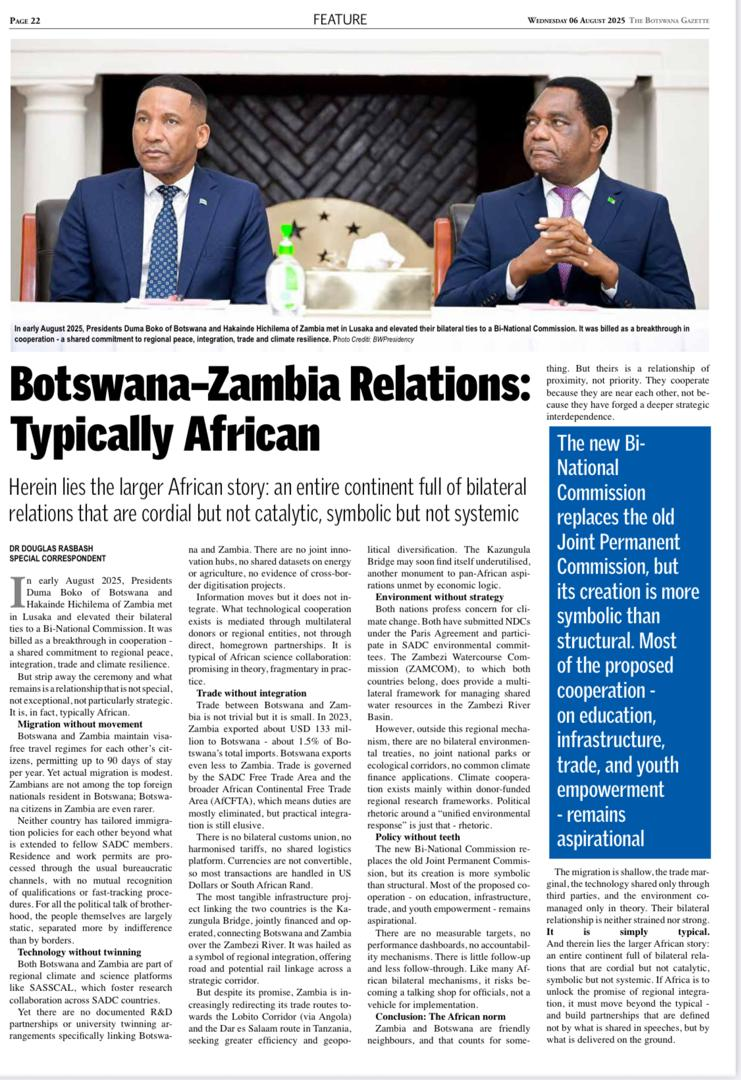
The two countries share a direct border. They now have the Kazungula Bridge linking them—built to speed up trade, improve logistics, and open up the flow of goods between the heart of Zambia’s fertile agricultural land and Botswana’s stable, strategically located economy. Yet, the trade volumes remain surprisingly modest.
Digging into the history revealed the reasons:
- Colonial-era infrastructure in Botswana was designed to connect southward into South Africa, not northward into Zambia.
- Zambia’s transport corridors historically looked east to Dar es Salaam or north to the Copperbelt–DRC axis, not west into Botswana.
- The two countries have very different trade regimes—Botswana in SACU (Southern African Customs Union), Zambia outside it—adding bureaucratic complexity.
- Above all, their production systems were built on a mindset of national self-sufficiency, not regional interdependence.
The Worldview Barrier: Why Africa Hesitates on Shared Production Planning
There’s a deeper reason why shared production planning has not yet become the norm across Southern Africa—and indeed, across much of the continent.
It’s not just about economics, logistics, or climate. It’s about trust, identity, and historical memory.
1. The Worldview Many African Nations Hold
This mindset is shaped by history:
- Colonial Borders: Arbitrary boundaries split ethnic groups, ecosystems, and trade routes, creating fragile national identities and cross-border suspicion.
- Post-Independence Priorities: Fresh from winning sovereignty, most nations pursued self-sufficiency as a shield against new forms of dependency.
- While Pan-Africanism was idealized, the political priority was state-building, often in isolation.
Result: A regional mindset of “we must be able to feed, power, and defend ourselves—even if our neighbours fail.”
2. The Fear of Vulnerability
For many governments, the idea of relying on neighbours for essential goods is uncomfortable—sometimes unthinkable—because:
- Political fallout or border closures can instantly cut off supply
(Nigeria’s 2019 border closure hurt Benin and Ghana). - Retaliatory tariffs, currency shifts, or transport disruptions can hit overnight.
- Loss of strategic control over food, energy, or jobs can undermine domestic stability.
These aren’t abstract fears. History offers reminders:
- Ethiopia–Eritrea war: shut down access to a vital port.
- Zimbabwe–South Africa tensions: threatened fuel and electricity supply.
- Xenophobic violence in South Africa: triggered economic boycotts from neighbours.
In short: political instability + weak institutions = fragile trust = limited interdependence.
3. Why There’s Hope for Shared Production
The barriers are real—but the reasons for optimism are growing:
a. AfCFTA (African Continental Free Trade Area)
Provides the legal framework to reduce tariffs and standardise trade, becoming the “container” for regional supply chains—if matched with real policy and infrastructure.
b. Climate Change
Droughts, floods, pests, and heat waves don’t respect borders. One country’s bumper harvest can buffer another’s crisis. Shared production is becoming a climate adaptation strategy, not just an economic one.
c. Digital Infrastructure
Satellite weather data, mobile payment systems, and real-time crop monitoring lower the cost and complexity of coordinated planning.
d. Youth and Entrepreneurial Energy
A younger, more Pan-African generation is emerging—eager to collaborate across borders, especially in agriculture, food tech, and logistics.
4. What Would Make It Real
For shared production planning to take root, we need:
| Enabler | Description |
|---|---|
| Trustworthy Institutions | Regional conflict resolution, mutual food reserve mechanisms, and joint planning councils. |
| Cross-Border Agro-Economic Corridors | Like the North–South Corridor, linking production, storage, and processing hubs. |
| Seasonal Crop Calendars | Shared schedules based on comparative advantage and climate, not political boundaries. |
| Mutual Food Security Agreements | Legally binding pledges to supply each other during shortages. |
| Pan-African Farmer Coops & Agribusinesses | Operating regionally to serve markets across multiple countries. |
5. Article Closing Thought
“Self-sufficiency is not the same as sovereignty.
In the 21st century, sovereignty may require interdependence.”
The dream of shared production is not naïve—it is necessary for a food-secure, prosperous, and climate-resilient Africa.
But it will only happen if we design systems of safety and trust that allow nations to give up just enough control to gain far greater collective security.
6. From Trade Links to Production Logic
That raised a new question:
What if instead of each country producing independently for itself, a greater share of production planning was coordinated regionally?
In other words: what if Southern African countries planned, rotated, and zoned their agriculture in a way that leveraged their comparative advantages, shared surpluses, and buffered each other’s deficits?
7. Why This Question Matters Now
Southern Africa—especially the SADC (Southern African Development Community) block—faces urgent pressures:
- Population growth over the next century that will sharply increase food demand.
- Climate change intensifying droughts, floods, and land degradation.
- Economic vulnerability to price volatility in global markets and external supply shocks.
- Migration pressures as rural livelihoods collapse and youth move to cities or across borders.
We also face a unique window of opportunity:
- The Kazungula Bridge and other infrastructure projects are physically connecting the region.
- AfCFTA and SADC frameworks provide a political platform for shared strategies.
- The rise of digital agriculture allows for coordinated planning, market transparency, and rapid response to shortages.
8. The Current State: Pre-Shared Model
Today, agriculture’s GDP contributions in SADC are far smaller than they could be—not only in dollar terms but also in job creation, market access, and land stewardship.
Take Botswana:
- Current agricultural GDP: ~USD 88 million (1.71% of GDP, official figure).
- Current production volume: ~320,000 MT (pre-shared baseline).
This reflects mostly self-sufficiency-oriented production, scattered processing capacity, and little leverage of regional comparative advantage.
Here’s how I’d shape that section so it flows naturally inside the main post after the “Worldview Barrier” and “What Would Make It Real” segments.
It builds on the trust-and-institution foundation, then elevates the conversation into a visionary, intergenerational pathway:
9. Shared Production Planning in Southern Africa
A 100-Year Intergenerational Framework for Regional Prosperity, Stability & Land Regeneration
This is not just an economic proposal—it’s a systems-level question that calls for:
- Intergenerational design (planning for 50–100 years, not just electoral cycles),
- Regional governance transformation (institutions built for collaboration, not just coordination), and
- Coordinated agro-industrial and socio-ecological planning (linking food security, jobs, trade, and environmental health).
I. System Conditions to Shift
| Legacy Mindset | Shift Required |
|---|---|
| National self-sufficiency goals | Regional complementarity with mutual buffering |
| Uncoordinated production | Coordinated crop and industrial rotation calendars |
| Extractive profit-seeking | Inclusive productivity with environmental stewardship |
| Export-oriented food supply chains | Dual systems: local nutritional security + export value |
| Unregulated free market | Bounded markets: innovation within protective floors |
II. Strategic Goals for the Next 100 Years
1. Covering Deficits in Production
- Develop a Regional Agro-Climatic Zoning Map to assign each country specific agro-ecological and agro-industrial roles.
- Use joint population and dietary forecasts to model per capita nutritional needs and capacity gaps by decade.
- Establish rotational surplus targets so each country produces a buffer surplus in its comparative advantage every 3rd year.
2. Improving Cost Efficiencies for Better Margins
- Pool procurement of seeds, irrigation, fuel, and equipment through a Southern Africa Production Pact (SAPP).
- Build shared processing and logistics parks at strategic border towns.
- Create a regional innovation and extension training loop to raise yields with minimal external inputs.
3. Creating Equitable Market Access
- Establish regional food and raw goods exchange boards with price floors and co-op representation.
- Digitalise producer networks to enable direct cross-border trading.
- Introduce regional certification & traceability so smallholders meet export standards affordably.
4. Correcting Wealth Concentration & Employment Gaps
- Embed employment elasticity targets in GDP growth policy.
- Promote value-added SMEs with majority producer ownership.
- Deploy automation where it augments—not replaces—human livelihoods.
5. Ensuring Land Regeneration & Reversal of Desertification
- Introduce rotational production–rest zones with agroforestry cycles.
- Create a Regional Regenerative Practices Registry.
- Implement a soil carbon reward system to finance land restoration.
III. Tools & Governance Structures Needed
| Tool / Mechanism | Purpose |
|---|---|
| Southern Africa Shared Production Planning Council (SASPP) | Oversees coordinated planning and compliance |
| Geo-Spatial Agro-Economic Planning Maps | Align land, climate, and trade corridors |
| SADC Agro-Food Sovereignty Scorecard | Tracks equity, employment & regeneration goals |
| SADC Mutual Buffer Stock System | Guarantees food supply during shocks |
| AfCFTA-aligned Shared Processing Zones | Integrates cross-border value chains |
| People’s Sovereignty Fund | Long-term reinvestment for land stewards |
IV. Cultural & Psychological Shifts Required
- From Nation vs. Nation → Region as Family — fostered through storytelling, shared history education, and regional rituals.
- From Productivity Measured in Tonnes → Health, Employment, & Soil Regeneration — realigned measurement systems.
- From Competitive Global Positioning → Cooperative Resilience — recognising that power lies in interdependence.
V. The Vision in One Sentence
A Southern Africa where no child goes hungry, no farmer stands alone, and no nation depletes its soil to prove its strength.
The Shared Production Planning Model
We modelled what could happen if SADC countries coordinated production planning, focusing on:
- Cereals (wheat, maize, rice, barley),
- Vegetables (tomatoes, potatoes, carrots),
- Fruits (bananas, citrus, apples),
- Fibers (cotton, flax, hemp),
- Oilseeds (soybeans, sunflower seeds),
- Medicinal plants,
- Livestock, poultry, and aquaculture.

Using each country’s climatic suitability and comparative advantage, we built a cross-border rotation and supply system designed to:
Cover production deficits anywhere in the region.
Reduce costs via pooled procurement, logistics, and shared processing.
Improve market access so producers are no longer price-takers.
Keep poverty and unemployment below a 3% threshold.
Regenerate degraded land, aiming for a 75% reduction in desertification in Namibia and other vulnerable zones.
10. What the Numbers Show
The results were eye-opening.
For Botswana:
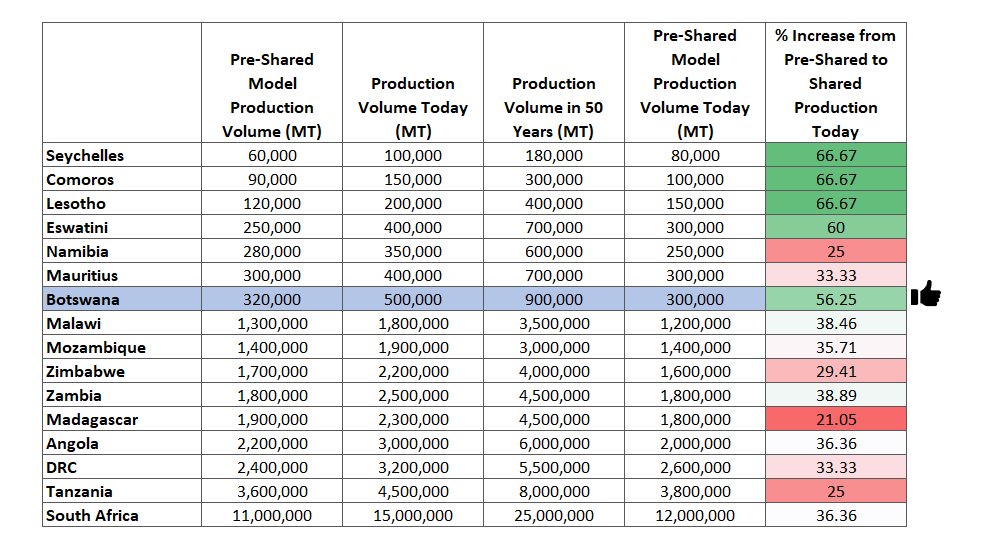
- Pre-Shared Model Production: 320,000 MT
- Shared Model Production (today): 500,000 MT (+56.25%)
- 50-year projection under shared planning: 900,000 MT (+181% over pre-shared baseline)
- Agricultural GDP (pre-shared): USD 88M
- Agricultural GDP (shared model today): USD 350M (+297.7%)
- Projected agricultural GDP in 50 years: USD 1.2B
Across SADC:
- Production volume gains: Average +35–55% immediately, +75–85% in 50 years.
- Agricultural GDP gains: +80% to +250% depending on country.
- Job creation: Millions of new agricultural jobs, many in rural areas, reducing migration pressures.
- Poverty reduction: Region-wide potential to push unemployment/poverty levels well under the 3% target—if value chains are managed inclusively.
11. Why the Gains Are So Large
The shared production model works because it:
- Reduces duplication: no more forcing crops in climates they fail in just for “self-sufficiency.”
- Builds rotational buffers: surpluses in one country feed shortages in another.
- Maximises processing efficiency: shared plants running at full capacity across seasons.
- Frees up land for regeneration: planned rest periods with cover crops and agroforestry.
12. What Needs to Shift in Worldviews
For this vision to happen, the region’s mental models must change:
To unlock shared production planning in Southern Africa—and across the continent—a profound shift in worldviews is required. These aren’t just policy changes or economic tweaks. They’re deep mental models, assumptions, and identity constructs that currently shape how each country sees itself, its neighbours, and its place in the world.
I. From “Sovereignty Means Self-Sufficiency” → “Sovereignty Through Interdependence”
Current Worldview:
“If we don’t feed ourselves, we risk being dependent—and exposed.”
New Mindset:
“If we co-design regional buffers and rotate production, we reduce risk, improve nutrition, and strengthen resilience—together.”
Each country must see its sovereignty not as autarky, but as part of a network of reliable partners, just like the EU with its Common Agricultural Policy (CAP).
II. From “Produce What We Can” → “Produce What We’re Best Suited For”
Current Worldview:
“We must grow maize even in deserts because our people eat it.”
New Mindset:
“We’ll produce what thrives best here and trade or stockpile for what doesn’t, while ensuring access for all.”
This requires trust in:
- Regional food storage,
- Functional cross-border logistics,
- Fair price setting.
III. From “Don’t Rely on Neighbours” → “Design Mutual Guarantees of Support”
Current Worldview:
“What if our neighbour becomes unstable or hostile?”
New Mindset:
“Let’s embed production agreements in regional governance and public law, so no one is left vulnerable in crisis.”
This requires:
- Binding regional protocols (e.g. emergency grain reserves),
- Legal trade corridors with priority access rules,
- Reciprocal penalties for breaking regional agreements without cause.
IV. From “GDP Competition” → “Collective Wealth & Employment Optimization”
Current Worldview:
“We want to be #1 in exports, yields, or investor interest.”
New Mindset:
“The real win is collective employment, food security, and land regeneration. We track progress in shared dashboards.”
This worldview shift allows:
- Joint tracking of poverty and employment,
- Shared targets for soil health and carbon sequestration,
- SADC-wide employment elasticity targets (e.g. every 1% GDP growth = 0.8% job growth).
V. From “Short-Term Political Gains” → “Long-Term Bioregional Stewardship”
Current Worldview:
“We must deliver results before the next election.”
New Mindset:
“Our legacy is what we leave behind for the next 3 generations, across borders.”
This requires:
- Citizen education in systems thinking,
- Cross-border farmer cooperatives, not just state-led programs,
- Political leadership that earns legitimacy through intergenerational vision.
VI. From “Africa = Commodity Exporter” → “Africa = Designer of Regional Systems”
Current Worldview:
“Let’s scale production to export raw goods.”
New Mindset:
“Let’s design and own our value chains—regionally and ethically.”
This means:
- Moving beyond colonial supply chains,
- Owning regional certifications, labels, and processing industries,
- Building African-centred trading standards and logistics systems.
🕸 Summary: Mental Model Shifts by Stakeholder
| Stakeholder | Shift Required |
|---|---|
| Policymakers | From protectionism to mutual guarantees & production zoning |
| Farmers | From subsistence nationalism to shared cluster strategies |
| Private Sector | From national silos to cross-border cooperatives |
| Youth | From job-seeking to system-building entrepreneurship |
| Donors/Investors | From pilot projects to supporting governance of shared systems |
| Citizens | From suspicion of neighbours to pride in interlinked food systems |
The updated SADC-Wide Shared Production Impact Model now includes:
🔹 % Increase from Pre-Shared Model to Shared Production Today (MT)
This reflects the immediate production uplift possible simply by shifting from isolated national production to coordinated shared planning—even before reaching long-term (50-year) projections.
📊 Examples:
| Country | Pre-Shared Volume (MT) | Shared Model (Today) | % Increase |
|---|---|---|---|
| Botswana | 320,000 | 500,000 | +56.25% |
| Namibia | 280,000 | 350,000 | +25.00% |
| Zambia | 1,800,000 | 2,500,000 | +38.89% |
| South Africa | 11,000,000 | 15,000,000 | +36.36% |
13. The Political & Economic Opportunity
The Kazungula Bridge is more than steel and concrete—it’s a symbol of what’s possible when SADC countries choose to connect. But connection in trade infrastructure is meaningless without connection in production planning.
The shared production model offers:
- Economic resilience – less exposure to global price shocks.
- Food sovereignty – through regional self-reliance, not isolated national silos.
- Climate resilience – coordinated adaptation to shifting agro-climatic zones.
- Wealth distribution – structured so it grows across the rural majority, not just export-facing elites.
14. A Call to Action
If you are a policymaker, agricultural leader, or regional business, here’s what’s needed next:
- Develop SADC Agro-Climatic Zoning Maps to guide production.
- Establish a Southern Africa Shared Production Planning Council to coordinate rotations, processing capacity, and logistics.
- Build mutual food security reserves with legally binding release protocols.
- Create a regional agri-GDP and employment dashboard to track shared progress.
The alternative?
Each country continues producing in isolation, vulnerable to droughts, price crashes, and political shocks, while the region’s full potential remains unrealised.
The original question was about trade between Zambia and Botswana.
The answer, it turns out, is not just about better trade flows—it’s about a new way of thinking: shared production planning as a regional strategy for prosperity, stability, and resilience.
“The Choice Before Us”
Subtitle: Resetting Our Minds for a Shared Future
When we step back and see the shared production model in its fullness, it becomes clear that many of the persistent challenges faced by each nation in isolation—food insecurity, uneven growth, job scarcity, market volatility, and land degradation—begin to resolve themselves in a coordinated regional approach. The real question is no longer whether we can design the systems to make this work; it is whether we can reset the settings of our minds.
The mechanisms are already within reach—in our data, our climate maps, and our trade corridors. What remains is the harder work: to look beyond the comfort of familiar habits, to question the post-independence reflexes of self-protection, and to decide whether holding onto them serves our future or quietly undermines it.
What divides us today could just as easily be the foundation of our collective strength. Many of the challenges we fight alone would shrink—or disappear—if we planned and produced together. The test is not in the fields, factories, or markets, but in our willingness to choose trust over fear, interdependence over isolation. Common sense says we can—and history will ask why we didn’t.
 Systems Thinking Research & Leadership Development Institute (STRLDi)
Leave a comment