
TOPICS TO SPEAK ABOUT
The following thoughts are drawn from my most recent post: “Misunderstanding Mastery: When The Fifth Discipline Is Adopted but Misaligned”
Read the article here ». Here are five meaningful and compelling topics to speak about under the theme Personal Mastery for Collective Impact, especially aligned with The Fifth Discipline:
1. Personal Mastery Is Not Self-Improvement—It’s System Stewardship
Clarify the distinction between personal mastery and individual success. This topic explores how personal mastery is not about self-perfection but about cultivating clarity, vision, and commitment that enable us to take responsibility for the systems we’re part of—family, team, community, or nation.
Key point: Personal mastery is not the destination; it’s the discipline of aligning one’s purpose with one’s practice—in service of the whole.
2. Living in Creative Tension Without Collapse
Teach how to hold a vision while staying grounded in current reality—a core capability of personal mastery. This talk can walk through how to navigate creative tension as a source of energy and growth, not anxiety or avoidance.
Key point: What separates dreamers from system builders is the ability to stay with creative tension long enough to let the system transform.
3. How Mental Models Limit—and Liberate—Collective Impact
Focus on the personal work of identifying and challenging our own mental models. Without this, we unknowingly replicate the very structures that sustain the status quo, even in our efforts to change it.
Key point: Systemic transformation begins with inner clarity. Unexamined assumptions are invisible handcuffs in the work of collective change.
4. Personal Mastery in the Face of Institutional Power
Explore how individuals can practice personal mastery even inside hierarchical, political, or bureaucratic environments—without becoming reactive, cynical, or co-opted.
Key point: The disciplined inner life allows individuals to stay anchored, to influence without force, and to model coherence in fragmented institutions.
5. Regenerative Leadership Begins With You
Link personal mastery to the larger arc of societal renewal—regenerative agriculture, education, governance, and climate action. Frame personal mastery as a necessary condition for collective resilience.
Key point: Systems don’t change because we shout louder. They change when enough people begin showing up differently, over and over again.
CONNECTING THE FIVE THEMES TO THE UNEMPLOYMENT STUDY
Here’s how we connect each of the five themes to our unemployment study [Link to the Unemployment Study Summary or Page: Addressing the Persistent Nature of Unemployment]—highlighting how personal mastery serves as a gateway to addressing systemic issues like persistent unemployment:
1. Personal Mastery Is Not Self-Improvement—It’s System Stewardship
Connection to the Study:
Your unemployment study reveals that persistent joblessness is not simply about skills gaps or economic cycles—it’s embedded in structural traps. Personal mastery allows leaders, policymakers, and citizens to see their role in sustaining or transforming these systems. It demands that we stop outsourcing responsibility and instead become stewards of the systems we inhabit.
The study invites leaders to stop diagnosing unemployment as a problem “out there” and instead see it as a reflection of fragmented national learning and alignment.
2. Living in Creative Tension Without Collapse
Connection to the Study:
Unemployment evokes emotional polarities—blame, despair, resignation. The study itself emerged from your ability to stay in creative tension for years—between Botswana’s current economic stagnation and your vision for a learning society. Helping others learn to stand in that tension—without escaping into short-term fixes—is central to lasting change.
The leadership needed now is not a saviour, but one who can hold tension without collapsing into old formulas or retreat.
3. How Mental Models Limit—and Liberate—Collective Impact
Connection to the Study:
A major finding of your unemployment study is the dominance of outdated mental models: employment as entitlement, economic success as tenderpreneurship, or job creation as government’s burden. Personal mastery is the discipline of examining these assumptions, replacing them with ones that unlock generative possibility.
Without revisiting our inherited mental models, we risk reinforcing unemployment even while trying to solve it.
4. Personal Mastery in the Face of Institutional Power
Connection to the Study:
Your path to conducting and sharing the study has revealed institutional avoidance and gatekeeping—yet you’ve stayed the course. This is a model of personal mastery in action. You can teach others how to build quiet, internal authority to challenge institutional stagnation without burning out or becoming oppositional.
Institutions may resist discomfort, but individuals within them can be carriers of coherence.
5. Regenerative Leadership Begins With You
Connection to the Study:
The unemployment crisis is not only economic—it’s a signal of depleted societal ecosystems: disengaged youth, weakened family systems, demoralized educators. Regenerative leadership, grounded in personal mastery, equips individuals to restore vitality, meaning, and creativity across the system.
This is not about jobs alone—it’s about cultivating systems that make meaningful participation possible again.
NOW CONNECTING THE ABOVE TO THE PODCAST QUESTIONS
We are now weaving the podcast questions in the five themes of Personal Mastery for Collective Impact and insights from our unemployment study:
🎙 1. What does mastery mean to you, and how has it shaped your journey?
Framing Response:
Mastery, to me, is not about reaching perfection—it’s about developing the capacity to stay in a generative relationship with reality. It’s the discipline of holding vision and current reality without collapsing.
In my journey—especially across 18 years of wrestling with the question of unemployment in Botswana—I learned that the trap wasn’t just external. The trap was also internal: the urge to abandon vision in the face of silence, fatigue, or rejection.
Personal mastery has allowed me to keep showing up, keep listening, and keep building—even when the system seemed unmovable.
Related theme: Living in Creative Tension Without Collapse
Related study insight: The study only came to life because I didn’t collapse the tension between what I saw and what was, even when others did.
🎙 2. What is the connection between Personal Mastery and Innovation?
Framing Response:
Innovation isn’t a flash of genius—it’s often the quiet, disciplined result of staying long enough with complexity. That’s what personal mastery enables. It trains your mind and emotions to hold paradox, to see interrelationships, to move beyond blame and defense.
The study on unemployment is itself an innovation—not in data, but in framing. It reframes unemployment not as a social failure, but as a systemic trap, kept alive by our mental models and governance designs.
Only with personal mastery could I allow new insights to emerge—not by force, but by deep seeing and patience.
Related theme: Mental Models Limit and Liberate Collective Impact
Related study insight: New pathways appeared when I began questioning inherited models about job creation and the economy.
🎙 3. What advice would you give to those seeking to align their personal growth with broader societal impact?
Framing Response:
Don’t chase visibility. Chase depth.
The world rewards performance, but systems transform when people do the quieter, internal work—unlearning, listening, practicing reflection. Aligning personal growth with societal impact means moving from reaction to responsibility.
If you’re serious about change, don’t rush to change others. Begin by seeing yourself in the system you want to transform.
And, if you’re working in government, research, or education, ask: Am I part of restoring the learning capacity of this system—or am I reproducing the old traps?
Related theme: Personal Mastery Is Not Self-Improvement—It’s System Stewardship
Related study insight: The study revealed that policy and organisational leaders often externalize blame—yet their own mindset is part of the unemployment trap.
🎯 THREE PUNCHLINE TAKEAWAYS FOR YOUR PODCAST
For a focused 1-hour podcast that introduces The Fifth Discipline, weaves in your unemployment study, and activates personal mastery, I recommend centering the conversation around three core takeaway punchlines that:
- Connect listeners emotionally and intellectually,
- Validate their experience (no matter where in the world they are), and
- Leave them thirsting to deepen their understanding and practice.
1. “Persistent unemployment isn’t just economic—it’s a systems trap we’re all participating in.”
🧭 Key Point:
The unemployment challenge in Botswana is not exceptional—it is exemplary. When we treat unemployment as a list of broken parts (skills gap, youth disengagement, economic cycles), we miss the invisible interdependencies and reinforcing feedback loops that keep it in place.🛠 What This Means for the Listener:
Whether in government, NGO, education, or corporate work—your daily decisions are part of the architecture of this trap. And with deeper systems insight, you can be part of the release.
🎤 Use This Segment to Introduce the Study:
Explain how the study began, what it revealed (e.g., delays, loops, blame shifting), and how these apply across any nation with persistent unemployment.
2. “The system won’t change if we can’t see ourselves in it.”
🧭 Key Point:
Most of us unconsciously replicate the very structures we want to change. Mental models—assumptions we carry about what causes what, who is responsible, and what’s possible—are invisible, but they run everything.🛠 What This Means for the Listener:
Start your practice by mapping what you assume to be true about unemployment, progress, leadership, or change. See how those beliefs show up in your team, your institution, your own leadership. That’s the work of personal mastery.
🎤 Bridge to: Mental Models & Creative Tension
Share a moment in your journey where seeing your own assumption changed the path forward in your study or your work.
3. “The Fifth Discipline is not just a toolkit—it’s an operating system for transformation.”
🧭 Key Point:
Many know of The Fifth Discipline—but few live it. It is not a method to apply to others. It is a way of being that restores meaning, coherence, and shared learning in complex environments.🛠 What This Means for the Listener:
If you feel stuck or uninspired, it’s not because transformation is out of reach. It’s often because we haven’t yet equipped ourselves with a way to see and move differently. The disciplines are not the end—they are how we get to the future we long for.
🎤 Close With a Picture of Possibility:
Paint a vision of what becomes possible when more leaders and communities begin to practice systems thinking and team learning in earnest—and how much lighter the work becomes when others walk with you.
🌀 Bonus Framing (optional):
“This is not a story about Botswana. This is a story about all of us.”
Let this echo as a call to action throughout the episode—grounding local insight into a global pattern of transformation needed.
PODCAST EPISODE OUTLINE
🎙️ Podcast Title:
“Unemployment, Systems Traps, and the Discipline of Transformation”
Why solving persistent problems begins with seeing the system—and ourselves—differently.
⏱️ Total Duration: 60 Minutes
This outline is structured to guide a reflective, grounded, and forward-looking conversation—moving from national challenges to inner disciplines and leadership practice.
🟢 [0:00–5:00] Opening: Welcome & Grounding the Conversation
- Welcome listeners with a grounding tone: reflective, rigorous, and hopeful.
- Introduce Sheila Damodaran, Founder of STRLDi and author of the first-ever global study on unemployment using The Fifth Discipline framework.
- Acknowledge the deep fatigue and confusion surrounding persistent social problems like unemployment.
- Set the stage for today’s exploration—of not only national systems but also the systems within ourselves.
🎧 Reflection Prompt:
“When you hear the word unemployment, what comes to mind? Is it a statistic? A government issue? A personal fear? A family story?”
🟡 [5:00–18:00] The Study: A Trailblazing Journey into Systemic Unemployment
a. The Process (8 mins)
- A global first in the The Fifth Discipline field.
- 16 years of patient waiting and strategic groundwork; 2 weeks to complete the actual research.
- Applied feedback loops, systems archetypes, delays, and the “Onion” model developed by Sheila in 2002.
- The opportunity emerged in 2008, but the country’s data readiness took until 2018.
- Emphasis on the discipline of waiting—transformation must be invited, not forced.
b. Key Findings (5 mins)
- Unemployment is not caused only by a lack of jobs—it is perpetuated by systemic loops: blame-shifting, delay, fragmented leadership, and low absorption capacity in agriculture/manufacturing.
- Botswana has received over 12 trillion pula in foreign and state investment since independence.
- Formal employment remains at 43% and GDP has stabilized around USD 20 billion, while economic output leaks via imports.
- Less than 10% of graduates are trained in STEM.
- 84% of children born in 2022 were to unmarried mothers—forecasted to reach 100% by 2030.
c. Why It Matters (2–3 mins)
- These structures are present in many countries facing persistent unemployment.
- It reveals how systems resist change even with well-meaning policy efforts.
🎧 Reflection Prompt:
“What if persistent problems aren’t just about failure to act—but about how we see, relate, and decide?”
🟠 [18:00–40:00] Three Punchlines: Personal Mastery for Collective Impact
🧠 1. Persistent Unemployment Is a System Trap (7 mins)
- Reinforcing loops maintain the status quo.
- Instead of job creation, efforts are absorbed by firefighting and sectoral underperformance.
- The economy fails to recirculate income effectively.
🎧 Prompt:
“What’s a trap your team keeps falling into? What patterns do you see repeating?”
🧠 2. The System Won’t Change If We Can’t See Ourselves in It (7 mins)
- Personal story: mental models of shame and visibility from a misrepresented newspaper article.
- Mental models shape institutional responses.
- Skill gaps and family systems perpetuate fragility in the labor force.
🎧 Prompt:
“What belief about success, visibility, or leadership might be keeping you stuck?”
🧠 3. The Fifth Discipline Is an Operating System for Transformation (8 mins)
- Not a toolkit, but a mindset.
- Personal mastery + systems thinking enable shared vision and deeper learning.
- The capacity to learn is a national asset.
🎧 Prompt:
“What would change if learning—not control—was the central value in your work?”
🔵 [40:00–52:00] Building the Practice: What This Means for the Listener
- Personal Mastery isn’t self-help—it’s disciplined commitment to reality and vision.
- Everyday Practice: Use end-state visioning in mundane tasks (e.g., visualising clean, stacked dishes to initiate action).
- Transformational Practice: Unlearn deeply embedded beliefs rooted in fear or outdated experiences.
- Organisational Practice: Work with others to see systems, clarify vision, and lead with learning.
🎧 3 Practical Invitations:
Revisit one issue you’ve given up on—could it be a systems trap?
Journal one belief about leadership or change—where did it come from?
Initiate a learning conversation: What might we not be seeing here?
🟣 [52:00–60:00] Closing: Vision, Hope & Invitation
- Share the metaphor: “Two arms—one for speed and one for learning. The second must lead the first.”
- Encourage listeners to build capacity for shared vision and real change.
- Share where to learn more (e.g. Sheila’s blog, the study summary).
🎧 Final Prompt:
“Who do you want to become in the system you’re part of?”
💬 Close With:
“This isn’t about fixing unemployment. It’s about becoming the kind of people and systems that make employment—and participation—possible again.”
🔗 Supporting Resources to Mention
[Sign-up page for future learning circles or podcast series]
[Link to Study Summary: “Addressing the Persistent Nature of Unemployment”]
[Sheila’s blog: https://sheilasingapore.blog]
🎙️ HOST SCRIPT & GUEST RESPONSE NOTES
[0:00–5:00] Opening: Welcome & Grounding the Conversation
HOST:
Welcome, everyone, to today’s episode, “Unemployment, Systems Traps, and the Discipline of Transformation.” I’m thrilled to be joined by Sheila Damodaran, founder of STRLDi, and a long-time practitioner of systems thinking through The Fifth Discipline framework.
Sheila, it’s great to have you here.
GUEST (Sheila):
Thank you. I’m grateful for the chance to bring this conversation into a broader space. It’s one I’ve lived with for a long time.
HOST:
Before we dive in, I want to invite you listener, to pause and reflect:
“When you hear the word unemployment, what comes to mind? Is it a statistic? A government issue? A personal fear? A family story?”
Keep that thought with you as we begin.
[5:00–18:00] The Study: Seeing the Unseen in Unemployment
HOST:
Sheila, you spent 16 years in-waiting to develop a national study on unemployment in Botswana but took two weeks to complete the research on the study. But it’s more than just about one country. Can you walk us through the process behind it?
GUEST (Sheila):
Yes, this is the first study of its kind globally in the field of The Fifth Discipline. When no one else has blazed the trail for you, you find yourself having to build it step by step. And sometimes, the path reveals itself only when both the country and the moment are ready.
When we finally stumbled upon that opening, it was in 2008. Even then, it took another ten years for the country to ready the data needed to complete the study. The work itself—organising, analysing the data, and structuring the research—took just two weeks. But the deeper work was in waiting with patience, trusting the country’s quiet process of readiness, and recognising that transformation cannot be forced—it must be invited.
Before that moment, however, I—together with officials in government offices tasked with the matter—would often sit with a tension we couldn’t ignore. We saw young people stuck. Institutions are trying, but falling short. Cycles repeat themselves despite the many efforts of the government and international partners.
From independence in 1966 to now, Botswana has received more than 12 trillion pula (USD 1.2 trillion) in investment. And yet, formal employment stands at just 43%, generating an annual GDP of USD 20 billion in recent years. For comparison, Singapore and Vietnam—two countries with very different economic paths—present a sharp contrast in scale and outcomes.
Botswana’s population has doubled over 60 years to about 2.5 million people. But the economy, in its current form, has not expanded to meet the needs of its people. That was the system we were seeking to understand—not just through numbers, but through the underlying structures and mental models shaping it.

Despite so, these have left 57% (or more than half of its working population) unemployed by the economy and without sustainable income for decades. I used systems thinking tools—feedback loops, archetypes, time delays backed by the onion (and rooted in the ten system archetypes Senge and his team at Innovation Associates (IA) developed). This is a model that I created in 2002 to explain the existence of large-scale systemic issues and to determine systemic interventions—to track how decisions were made, how blame was shifted, and where accountability fractured.
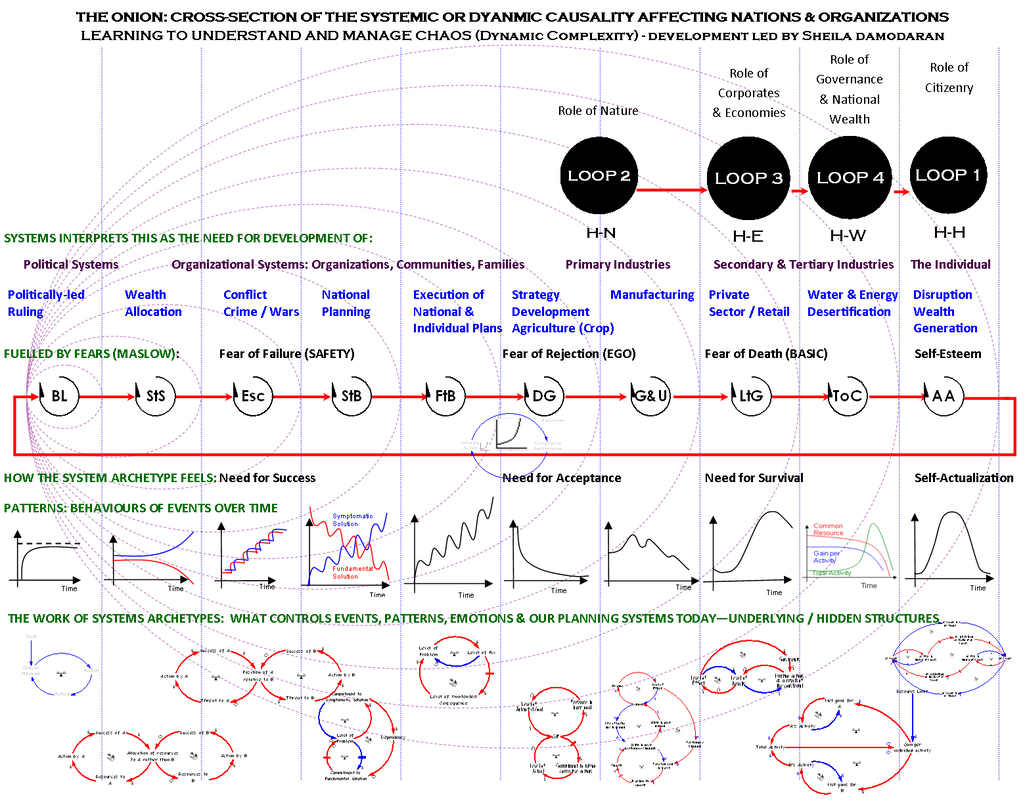

Over the years, as conditions evolved, I kept remapping. That’s what makes this study both rooted in Botswana and relevant to many countries experiencing persistent unemployment.
HOST:
Can you highlight the key insights?
GUEST:
The main one: unemployment is not just caused by a lack of jobs. It’s sustained by the way systems are designed—how leaders think, how institutions respond, and how we manage fear and uncertainty at personal and household levels.
We found reinforcing loops of inaction, short-termism, and disjointed efforts that together created what I call a “systems trap.”
HOST:
And this isn’t just about Botswana…
GUEST:
Exactly. The patterns are present globally wherever unemployment resists policy or programmatic intervention. The trap is in how we see the problem, not just how we try to fix it.
HOST Reflection Prompt:
“Think of a persistent problem in your context. Could it be that the way we’re seeing it is part of what’s sustaining it?”
[18:00–40:00] Three Punchlines: Personal Mastery for Collective Impact
Punchline 1: Persistent Unemployment Is a System Trap (7 mins)
HOST:
Let’s get into the first major takeaway: unemployment as a system trap.
GUEST:
Absolutely. Most people tend to attribute unemployment to weak education systems or unpredictable market forces. But what emerged from the study was something deeper—a closed-loop system. The private sector, in its current form, struggles to generate revenues that consistently exceed its operational costs.
Sectors like retail—especially food, household goods, and personal items—alongside the rentier economy, tend to fare better. But the sectors that could truly absorb large numbers of the unemployed—namely agriculture and manufacturing—are structurally underperforming. They account for less than 1% of the economy and formal employment, often ten times less than what’s needed to support broad-based economic participation.
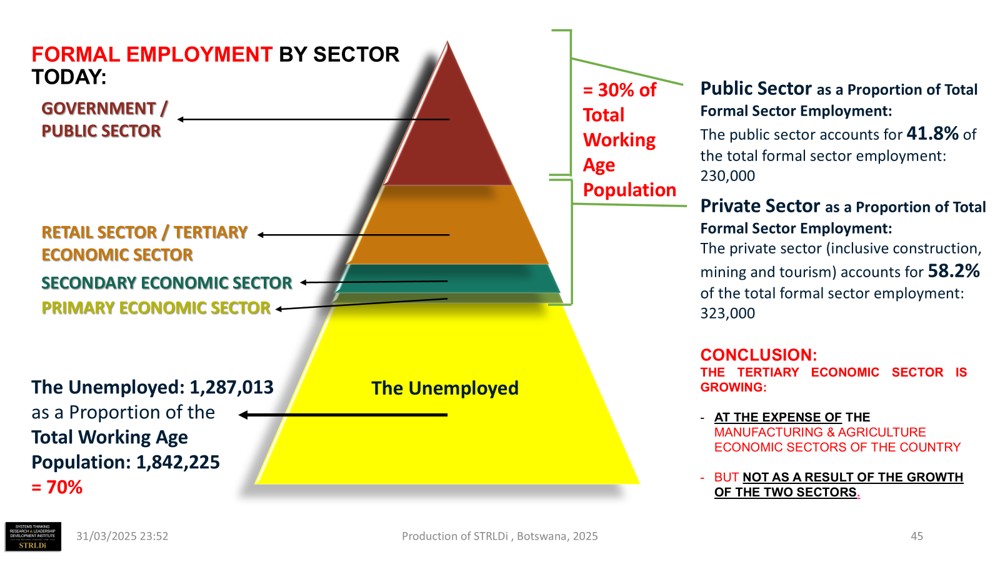
This imbalance has a major knock-on effect: the country ends up importing a large share of what it consumes. As a result, much of the income earned by those employed exits the economy, cutting off critical revenue streams for local businesses. So, you end up with an economic engine that just doesn’t recirculate its own energy.
Personal mastery, in this context, means seeing these loops for what they are—acknowledging reality objectively—and choosing not to keep reinforcing them.
Reflection Prompt:
“What loops do you keep seeing in your team or organisation that seem impossible to break?”
Punchline 2: The System Won’t Change If We Can’t See Ourselves in It (7 mins)
HOST:
Your second point is deeply personal—it’s about recognising ourselves in the system.
GUEST:
Yes, absolutely. For many years, I watched how easily we blame institutions for what’s not working. But eventually, I had to turn the question inward: what assumptions are we, as a society, holding onto? What do I believe about change that might actually be keeping us stuck?
That’s where the discipline of mental models comes in—it’s about examining the internal beliefs that shape how we see the world and act within it.
What we found in the study is that more than 90% of Botswana’s population is not skilled in STEM fields. Even among tertiary graduates, only about 10% are trained in disciplines like mathematics, engineering, or the physical sciences. The vast majority are concentrated in soft sciences—business, education, social work, healthcare. This skills profile has serious implications for Botswana’s capacity to build strong, competitive value chains in sectors like agriculture and manufacturing.

One of the deeper insights came when we examined family structures. The data shows a steady rise in children being born into households without a resident male figure. In 2022, over 84% of births were to mothers not married at the time of birth—and that trend is on track to reach nearly 100% by 2030. That’s a fundamental shift in household structure. Many of these mothers are themselves unemployed and raising children without consistent support, relying instead on informal networks or state assistance.
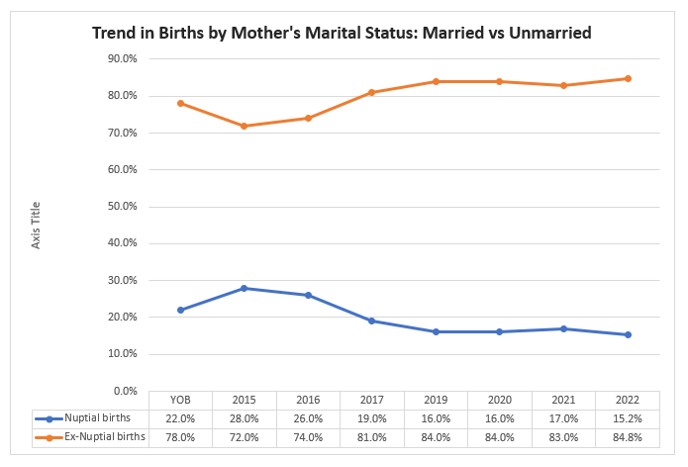
This has direct implications for child development. Children raised in these settings tend to do better in the soft disciplines—the social sciences, teaching, and care professions. But they often underperform in STEM. And part of that comes down to early exposure: male mentors—particularly fathers—often play a unique role in cultivating abstract reasoning, persistence, and spatial problem-solving. These are foundational to mastering math, physics, and engineering.
So, what does this mean for our national development? If we don’t strengthen family systems—particularly through gender-balanced parenting—our children will continue to be underprepared for the technical demands of the future economy. And without that foundation, no education reform or industrial policy will be enough.
Reflection Prompt:
“What beliefs about change or leadership might you be carrying that are limiting your impact?”
Punchline 3: The Fifth Discipline Is an Operating System for Transformation (8 mins)
HOST:
Your third punchline is that The Fifth Discipline isn’t a toolkit, it’s an operating system.
GUEST:
Yes. It’s not about workshops or checklists. It’s a way of seeing, relating, and acting that allows learning to happen in complexity.
We have to reintroduce learning as a strategic capacity—not just for individuals, but for teams, institutions, and nations.
Reflection Prompt:
“What would shift if learning became the organising principle of your organisation or life?”
[40:00–48:00] Three Pathways of Practice: Everyday, Transformational, and Organisational
HOST:
Sheila, you’ve recently written about three levels of personal mastery—everyday, transformational, and organisational. Can you walk us through them?

GUEST:
Yes, these emerged from years of working with individuals and organisations grappling with complexity.
Everyday Practice focuses on simple, repeatable acts that build inner steadiness and clarity. These might include:
- Practising personal visioning during daily tasks
- Focusing on the end-state (not just the to-do)
- Checking in with your internal state before acting
Transformational Practice involves deeper shifts. Like the story I shared about the 2011 newspaper article—where a misrepresentation shaped how I showed up. It took disciplined reflection to say:
“That article was misinformed. But it no longer gets to shape how I see myself.”
“The silence that followed—media, government, or allies—hurt. But their silence is not my shame to carry.”
These are pivotal shifts. They unlock new ways of being.
Organisational Practice brings teams together using tools like mental model mapping, the onion model (as used in the unemployment study), and scenario planning. These are not checklists—they are invitations to co-create shared meaning and vision.
GUEST (continued):
Ultimately, personal mastery is the root system from which leadership, organisational resilience, and national transformation must grow. We cannot outsource it. We can only practice it—together.
[48:00–56:00] Building the Practice: What This Means for the Listener
HOST:
What are practical ways listeners can begin this journey?
GUEST:
Start with these three invitations:
- Revisit one issue you’ve given up on—could it be a systems trap?
- Examine an assumption you’ve inherited.
- Initiate a learning conversation with someone you trust.
This is how personal mastery becomes collective impact.
[56:00–60:00] Closing: Vision, Hope & Invitation
HOST:
Sheila, as we close, what vision do you hold for those listening?
GUEST:
That we create two strong arms: one that builds fast, and one that learns deeply. The second arm must lead the first.
We’re not just solving unemployment—we’re rebuilding the capacity of societies to learn together.
HOST:
Thank you for your voice, your vision, and your resilience. For those listening, check the show notes for links to the study and Sheila’s blog and LinkedIn pages sheilasingapore or you can reach her on her WhatsApp at +267-75-987-534.
Final Reflection:
“Who do you want to become in the system you’re part of?”
Closing Line:
“This isn’t about fixing unemployment. It’s about becoming the kind of people and systems that make meaningful participation possible again.”
PROMOTIONAL ONE-PAGER
🎙️ PODCAST EPISODE ANNOUNCEMENT
Title:
Unemployment, Systems Traps, and the Discipline of Transformation
Why solving persistent problems begins with seeing the system—and ourselves—differently.
Release Date: August 2025
Duration: 60 minutes
Hosted by: Sheila Damodaran, Founder of STRLDi
Available on: Spotify | Apple Podcasts | Google Podcasts | sheilasingapore.blog
WHAT THIS EPISODE IS ABOUT:
This isn’t just a podcast episode. It’s the global unveiling of the first-ever national study of unemployment through the lens of The Fifth Discipline.
Join systems strategist Sheila Damodaran as she shares the powerful journey of a study 18 years in the making, completed in just two weeks once the country was ready. More than an analysis of Botswana’s unemployment crisis, this episode reveals how deeply-rooted mental models, systems traps, and broken feedback loops continue to shape national policy failure across the globe.
Whether you’re a policymaker, corporate leader, systems thinker, or organisational change agent, this episode shows how Personal Mastery is not just personal—it’s the first discipline of collective transformation.
EPISODE HIGHLIGHTS
✅ How unemployment is sustained not by lack of jobs, but by reinforcing systemic design
✅ Why transformation can take years of waiting, then only weeks to complete
✅ How family structure and national STEM readiness are systemically linked
✅ Why shared vision and mental model dialogues must precede policy reforms
✅ What leaders can do to begin the journey of collective impact today
KEY SEGMENTS
[0:00] Welcome & Reflection
[5:00] The Unemployment Study: Process + Findings
[18:00] The Three Punchlines: Personal Mastery for Collective Impact
[40:00] Three Levels of Practice: Everyday, Transformational, Organisational
[52:00] Closing Vision & Invitation
SHAREABLE QUOTES
“When no one else blazes the trail for you, you build it step by step. Sometimes, the path reveals itself only when the country is ready.” — Sheila Damodaran
“This isn’t about fixing unemployment. It’s about becoming the kind of people and systems that make participation possible again.”
LISTEN, REFLECT, SHARE.
Join the conversation. Start your practice. Help transform systems from the inside out.
🔗 sheilasingapore.blog
🎧 @STRLDi on Spotify & Apple Podcasts
#PersonalMastery #SystemsThinking #TheFifthDiscipline #UnemploymentStudy #STRLDi #Leadership #OrganisationalLearning #MentalModels #Transformation #AfricaLeadership
 Systems Thinking Research & Leadership Development Institute (STRLDi)
Leave a comment