
When you realize a situation is not as simple as it seems to be.
There is more to the discipline of Systems Thinking than meets the eye!
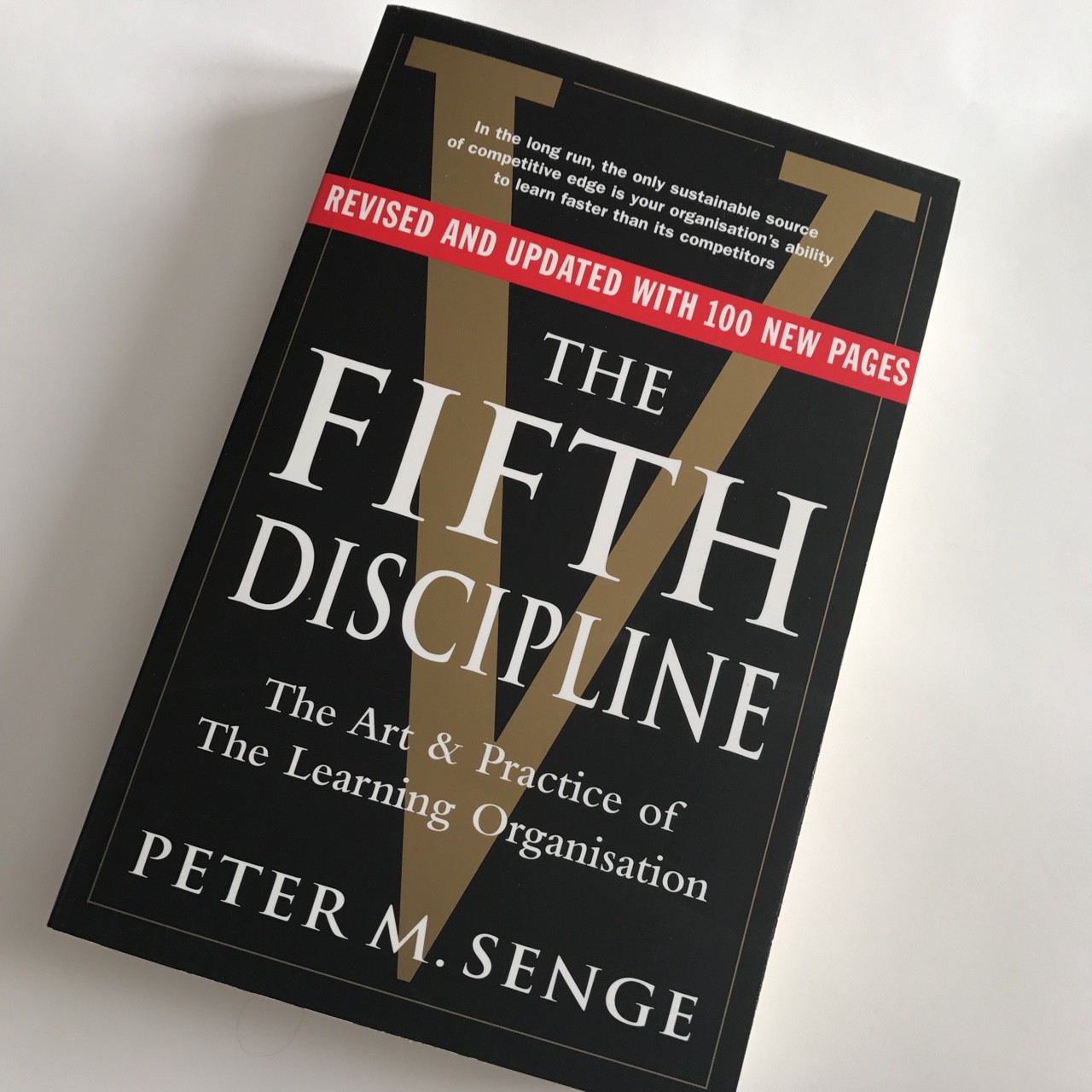
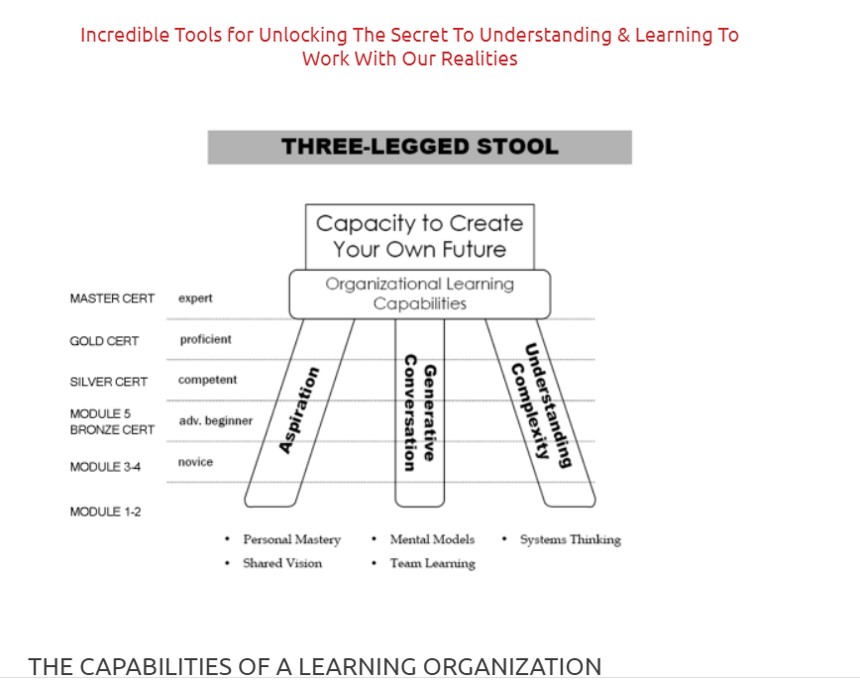
Peter Senge, who popularized learning organizations in his book The Fifth Discipline (extracted from HBR), described them as places “where people continually expand their capacity to create the results they truly desire, where new and expansive patterns of thinking are nurtured, where collective aspiration is set free, and where people are continually learning how to learn together.” To achieve these ends, Senge suggested the use of five “component technologies”: systems thinking, personal mastery, mental models, shared vision, and team learning.
HBR
Incredible Tools for Unlocking The Secret To Understanding & Learning To
Work With Our Realities

A METAPHOR FOR UNDERSTANDING THE PRACTICE OF
THE FIVE DISCIPLINES
OPENING
Today’s reality is the outcome of the mental images we had in mind in the past, in response to the question “What do we care to create?” These images come into being whether we are aware of them or not. As our collective visions unfold, we become aware of our current reality. If we can comprehend and collaborate with the interconnectedness of our individual visions at the time we imagined them, our current reality would be less tumultuous.
When individuals within an organization are not actively involved in the process of creating a shared vision, it often leads to chaos. This is a clear indication of systemic problems or circular causations that have been ignored but are now manifesting themselves. These issues become more persistent over time and therefore become increasingly challenging to resolve. Because systemic issues are often hidden and widespread, it is essential to develop the discipline to step back and identify the underlying structures that contribute to these problems. Only then can we work to turn them around and put an end to their persistent or vicious natures. This is critical for building a better tomorrow.
To effectively resolve a problem, we must first understand the nature of its cause and why it persists (as seen in the example of the ‘uncle’ discussed in Modules 1 and 2). This requires unlocking the secret to understanding our realities, which we can achieve through the use of the five “component technologies” suggested by Senge: systems thinking, personal mastery, mental models, shared vision, and team learning. Through the use of these strategies and by developing learning organizations, we can create spaces that allow us to achieve these ends.
The first step to learning is therefore learning to spot systemic or persistent issues.
A true hallmark of a leader is the cultivation of this capacity, not solely for personal growth but also for fostering it in those around them. This endeavor lies at the heart of the transformative work that unfolds within learning organizations, communities, nations, regions, and, one could even venture to say, the global stage. Who knows, perhaps it extends even to the boundless expanse of the universe?
HOW DO WE SPOT SYSTEMIC ISSUES AND / OR PERSISTENT ISSUES?
The principles of dynamic complexity are meticulously designed to confront these intricate challenges. When you come across discussions centered on these principles during your routine meetings or within the organization, they act as indicators signaling the presence of such complex issues. The initial step for individuals engaging in these conversations is, naturally, to attain a profound comprehension of the fundamental laws that underpin dynamic complexities.
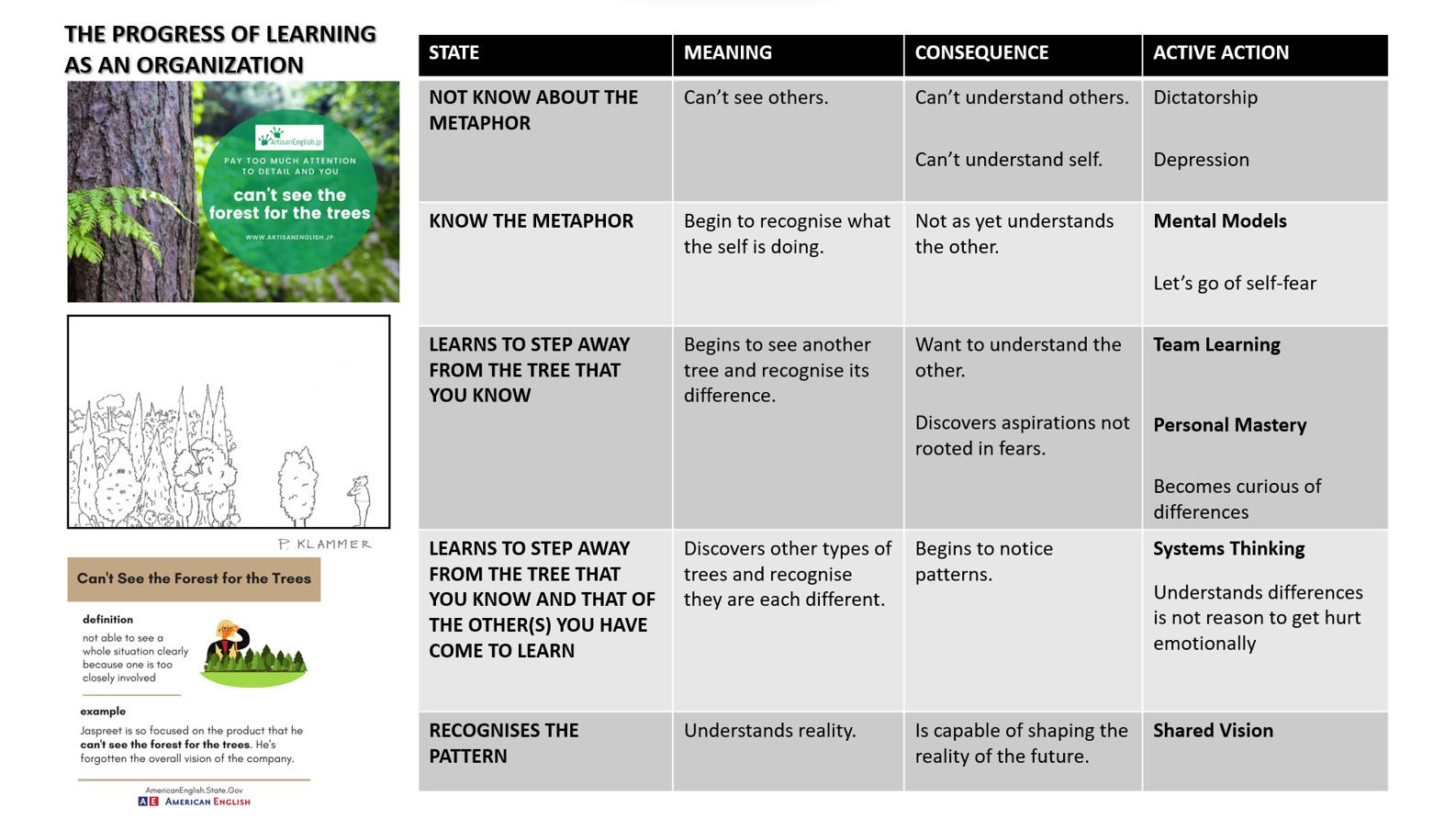
Our conventional education system, however, has predominantly equipped us with skills tailored for navigating intricate details. It has trained us to scrutinize the tree up close and discern the nuances in the bark. While this skill is undeniably valuable, systemic issues often unfold on a broader scale, necessitating a shift in perspective from the individual tree to the encompassing forest. Disciplines like Mathematics, Biology, Physics, and Chemistry have paved the way for grasping the holistic picture. With a solid grasp of the laws governing dynamic complexity, we gain enhanced capabilities to distinguish the forest from the trees and to pinpoint systemic issues with greater precision.
Now, let’s delve into the laws of dynamic complexity and unveil their presence.
TODAY’S PROBLEMS COME FROM YESTERDAY’S SOLUTIONS.
It may be tempting to point fingers at our leaders, assuming they are unwilling to assist us in ‘making things happen’ and addressing the escalating challenges we face. These challenges encompass various aspects of life, from employment and family dynamics to affordable housing, health, wealth, and the pursuit of a crime-free, corruption-free, and violence-free existence. Some even yearn for a world at peace, either in their thoughts or in reality.
Yet, it is undeniably more difficult to turn the mirror inward and hold ourselves accountable for not recognizing the vicious nature of the intricate web of causal factors that obstruct the realization of our desired outcomes. Nonetheless, when we take this introspective or reflective approach, we begin to understand that, unless we collectively engage in learning and assume a role in guiding our leaders, they often find themselves isolated and ill-equipped to decipher the intricacies of systemic challenges.
THERE IS NO BLAME.
Consequently, leaders often opt for tactics such as manipulating public perception, leveraging the media and social platforms, dedicating substantial time to form personal and political alliances, intentionally or inadvertently instilling fear, fostering conflicts, wielding authority, influencing judicial systems, pursuing government funding, and allocating resources, among other strategies. These actions have become such commonplace practices in our present-day society that we often overlook their profound implications and regard them as routine, despite their far-reaching consequences.
THE HARDER WE PUSH, THE HARDER THE SYSTEM PUSHES BACK.
While leaders may believe they hold the reins when it comes to allocating national resources and effecting change, the reality is quite different. Regrettably, we didn’t select them for their ability to comprehend and resolve these complex issues. Instead, our choices were often influenced by their willingness to be amenable to our requests, granting us an easy means to achieve our desires, whenever we wished. In doing so, we seem to overlook the fact that we have willingly engaged in a game of “who holds the upper hand. Phrases like “Me First,” “This Takes Too Long,” or “This is too hard for me or impossible for my adversary” all stem from this same game.
THE EASY WAY OUT LEADS US BACK IN.
In essence, the fundamental truth remains that meaningful solutions will emerge when we collectively embark on a journey of shared learning about the intricacies of our realities and the underlying systemic dynamics that govern how things truly unfold. However, this endeavor is undeniably challenging. It’s at this point that, in my perspective, the democratic process, wile it is easy. still reveals its shortcomings.
THE BEHAVIOUR GROWS BETTER BEFORE IT GETS WORSE.
Consequently, until this transformative collective learning occurs, many of us find ourselves skilled at containment rather than true resolution. Nevertheless, this approach comes at a price, and we will bear the cost. As long as these systemic issues remain unaddressed, they will persist and therefore persist in depleting our valuable resources as well.
THE CURE CAN WE WORSE THAN THE DISEASE.
The disease is already bad. The cure makes it worse.
I have witnessed agricultural regions where, in their quest for resilience against water scarcity and economic growth, unintentionally accelerated the aridification of their local climate. This phenomenon occurs because these drought-resistant plants contribute even less moisture to sustain the natural water cycle. While the shift toward drought-resistant crops is initially viewed as a prudent strategy, its effects can be deceptively temporary. It offers relief to the farmer for a brief span, typically lasting three to four, or at most six seasons. I suspect that Africa is not the sole region grappling with these unintended consequences.
A solution that is aimed at mitigating the impact of droughts often inadvertently perpetuates the cycle of droughts in the long run. Unfortunately, such solutions have become deeply ingrained, not only in our practices but also in our traditions, affecting vast regions of Africa, where the frequency of droughts is on the rise. Paradoxically, this drives communities to seek out crops that are progressively more resilient to drought, perpetuating the same cycle. This critical aspect frequently eludes our attention, particularly in the context of the complex El Niño effects, unless we examine historical data over time.
SYSTEMIC ISSUES: UNLEASHING FORCE SIMILAR TO “HURRICANES”
Just as real-life hurricanes possess formidable and destructive power, systemic issues mirror the intensity of these natural disasters. Similar to the way hurricanes can rapidly escalate within one or two days, systemic problems often catch us off guard with the sheer magnitude of their impact, when they blow up.
Consider the staggering global resources that have been allocated to combat issues like crime, healthcare, and conflicts:
ON CRIME:
Mass incarceration doesn’t do much to fight crime. But it costs an absurd $182 billion a year.
We could eliminate tuition at every public college and university in America with the $80 billion we spend each year on incarcerations – Obama
/cdn.vox-cdn.com/uploads/chorus_asset/file/7870673/mass_incarceration.png)
Source: https://www.vox.com/policy-and-politics/2017/1/27/14388024/mass-incarceration-cost (Retrieved on May 27. 2018)
Source: Norton, R. Graham F. and Ken C. (2004). What does the world spend on Criminal Justice? http://www.heuni.fi/material/attachments/heuni/papers/6KtlkZMtL/ HEUNI_papers_20.pdf (Retrieved on May 27. 2018)
ON HEALTHCARE:
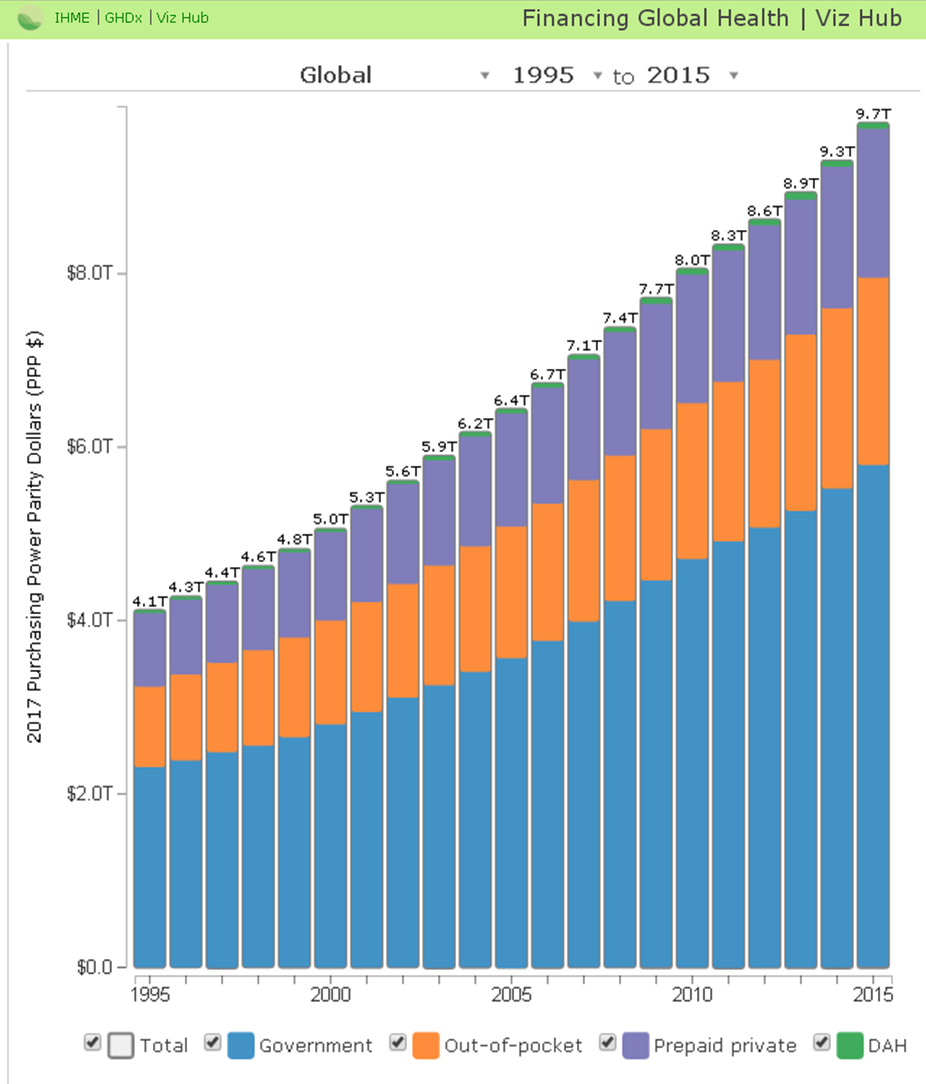
Global spending on health is expected to increase from US$7·83 trillion in 2013 to $18·28 (uncertainty interval 14·42–22·24) trillion in 2040 (in 2010 purchasing power parity-adjusted dollars).
We expect per-capita health spending to increase annually by 2·7% (1·9–3·4) in high-income countries, 3·4% (2·4–4·2) in upper-middle-income countries, 3·0% (2·3–3·6) in lower-middle-income countries, and 2·4% (1·6–3·1) in low-income countries.
Source: http://www.healthdata.org/data-visualization/financing-global-health (Retrieved on May 27. 2018)
Source: Joseph L D, PhD. (2016). National Spending on Health by source for 184 countries between 2013 and 2040 https://www.thelancet.com/journals/lancet/ article/PIIS0140-6736(16)30167-2/abstract (Retrieved on May 27. 2018)
ON THE MILITARY:
U.S. Military Spending vs. the World
The U.S. outpaces all other nations in military expenditures. World military spending totalled more than $1.6 trillion in 2015. The U.S. accounted for 37 percent of the total.
U.S. military expenditures are roughly the size of the next seven largest military budgets around the world, combined.
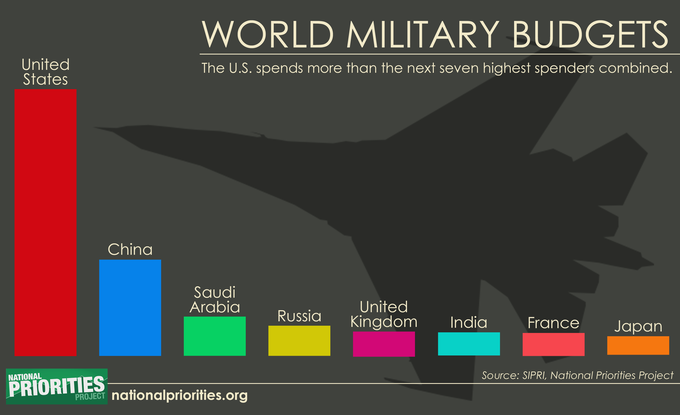
U.S. military spending dwarfs the budget of the #2 country – China. For every dollar China spends on its military, the U.S. spends $2.77.
Source: https://www.nationalpriorities.org/campaigns/us-military-spending-vs-world/ (Retrieved on May 27. 2018)
These numbers are not small. They are severe and serious. Just as they would compare with the intensities of real-life superstorms and hurricanes. We do not notice them because they build up over long periods of time and so their magnitude is not as apparent as the whiplashing effects and strengths of real-life hurricanes.
However, that does not mean they are no less intense in their effects. Here is a whopping USD 2,000 (or Botswana Pula 20,000) that governments spend annually on each citizen of the globe to administer just the three areas. This is before including other significant areas of public spending such as education, social welfare benefits, subsidies, salaries, and infrastructure development (which adds up to USD20,000 (200,000 pula) annually per global citizen. Multiply that with decades of administering them. That is USD1,500,000 (15,000,000 pula) every government spends on EACH GLOBAL CITIZEN in their lifetime. These amounts are staggering (as big hurricanes) given most of us do not pay such tax amounts in our lifetime.
Now, the question that calls for our attention is this: Given the substantial global investments in combating issues such as crime, healthcare, wars, education(1) and more, how much progress have these expenditures actually achieved in rectifying these problems? Is it a mere 5% improvement, a substantial 50%, or a transformative 100%? Do we possess this crucial knowledge, and more importantly, should we?
(1) Education: Among OECD countries, the average rate of degree attainment among 25-to-34-year-olds is 44% (a figure that reaches above 50% in nine member states, including Canada, Japan, and the United Kingdom).
FASTER IS SLOWER.
OUR GROWING NUMBNESS TO THEIR PRESENCE
In the event of a fire occurring at this very moment, our natural adrenaline response would engage, prompting swift reactions. Some might instinctively flee to safety, while others would immediately take action to fight and extinguish the fire before it can escalate.
The majority of our internal mechanisms for identifying and responding to threats to our survival are finely tuned for abrupt, dramatic changes in our environment, rather than gradual, incremental shifts.
Our minds are locked in one frequency, it is as if we can only see 70 km/h, we can’t see anything at 30 km/h. We will not avoid the fate of the frog until we learn to slow down and see the gradual processes that often pose the greatest threats (p. 23).
When we create Gantt charts to orchestrate the rollout of programs, it’s relatively clear how much time is needed for implementation. However, what often remains less transparent is the time required for the program to yield the desired change. This discrepancy frequently leaves us perplexed as to why our well-intentioned efforts to manage change fall short.
The root of this challenge lies in our lack of awareness regarding the causes and the gradual pace that led us to our current state. When change was unfolding slowly, it often went unnoticed, and we grew accustomed to its presence, much like the proverbial boiled frog that remains unaware of its predicament. We allow these incremental shifts to creep up on us, underestimating their potential impact until they crystallize into a crisis. At that juncture, we tend to respond mechanistically, either attempting to combat the crisis, struggling to manage the change, or even relinquishing the project entirely when change doesn’t materialize within our expected timeframe. This dynamic exemplifies the true nature of systemic issues, and our reactions to them tend to be more mechanistic than they ideally should be.
Learning to decelerate our often frantic pace and paying heed to both the subtle nuances (the trees) and the overarching dynamics (the forest) is the initial step in recognizing and effectively engaging with the actual pace of change associated with these complex issues.
WHAT DO STUBBORN OR SYSTEMIC ISSUES LOOK LIKE?
They are just that. Stubborn or as we would say politely, persistent.
Their typical nature is:
- Global, regional, or national in their effect on citizens and the lands, such as low agriculture output, crime, productivity, unemployment, poverty, infections, droughts, inflation, stifled wage increases, rising budget deficits, debts, floods, pollution, and so on. The incriminators across the globe may differ but the impact they create does not.
- Continues to exist despite ongoing efforts to manage it. Think crime. For as long as we know. states across the globe have spent resources amounting to billions and trillions of dollars on the economy to equip and build policing and rehabilitation organizations to fight crime. Or think of HIV infections. Think how many personnel and medications have we replaced and changed to fight it? Have these rates decreased despite the attention and budget we had allocated to them or do they persist or appear to decline but assume new forms? Of course, we are relieved they did not get worse. However, if they have resisted our efforts to change their course, i.e. to decline commensurate with resources that incline, then we have a persistent issue in our hands.
And so a problem or issue is systemic when:

- Different persons report the same concern in different locations, and at different times over different periods of time e.g. crime, unemployment, divorces, HIV/AIDs, drought, conflicts, corruption, violent behavior between couples, and so on. The perpetrators, victims, and circumstances, may differ but the problem and their impact do not change significantly spatially or temporally. Most times governments in their enthusiasm to ‘serve the people’ set up service centers to receive and file such complaints and to dole assistance out, would be able to see this is happening, provided they would lift their heads up from biting the sand (dealing with the files) long enough to observe these prevalences;
- Institutions set up by governments and funds set aside by the planning functions specifically targeted to deal with the problem, yet should you however, add up the resources applied cumulatively over the years since their inception and find the results do not commensurate (e.g. decline) with the incline of resources applied, and you are forced to keep chasing for the money to deal with them, then that is a sign you have a problem in your hand that persists and is systemic.
YOU CAN HAVE YOUR CAKE AND EAT IT TOO, BUT NOT AT ONCE.
At times, the most complex predicaments, when examined through a systems lens, reveal themselves as not dilemmas at all. This perspective necessitates a departure from static thinking, where results are perceived as snapshots frozen in time. Instead, it invites the embrace of “process thinking,” wherein we consciously consider change unfolding over time.
The seeming rigidity of “either-or” choices arises because we tend to envision what’s feasible within a specific moment, and we assume that we must make an exclusive selection. However, the real breakthrough comes when we perceive the potential for both options to evolve and improve over time. In essence, it’s about recognizing that the solutions aren’t mutually exclusive; rather, they can harmoniously progress in tandem, offering a more nuanced and effective approach to addressing complex challenges. We could have both goals if we are willing to wait for one while focusing on the other which will in turn grow the first.
SMALL CHANGES CAN PRODUCE BIG RESULTS, BUT THE AREAS OF THE HIGHEST LEVERAGE ARE OFTEN THE LEAST OBVIOUS.
DIVIDING AN ELEPHANT IN HALF DOES NOT PRODUCE TWO SMALL ELEPHANTS.
WHAT DOES IT MEAN TO “SOLVE A PROBLEM”?
So what does it mean to solve a problem? Click here for more.
Cause and effect are not closely related in time and space.
SO WHAT HAPPENS NEXT? HOW WOULD YOU TREAT THEM?
The advances we have made here with strategy and management development will allow us to do so. Finally.
This series of blogs and pages is a way to help me put out there the hope we would learn to see and understand these vicious structures that work at eroding:
- Our relationships with each other (as individuals, families, organizations, and communities, with each other),
- Our relationships with nature (health, environment, agriculture, animal and wildlife),
- Our relationships with ourselves particularly in developing the verve and tenacity to grow as nations (relations with ourselves and the economies/infrastructure/ technology we create to aid our existence on this earth) and,
- Our relationships with the rest of the world (seeing growth happen systemically).
It is in learning to turn these vicious (or negative) circles of causality around to positive natures that bear the fruit of hope in turning our realities around for us.
Love to hear your reactions and comments here.

 Systems Thinking Research & Leadership Development Institute (STRLDi)
Hi Sheila, as I am reading your blog, I am reminded of a stubborn problem in hospitals – patient falls! Despite all out efforts to solve them, they just stick around! Patients, especially the elderly ones, tend to want to move on their own and in the process sometimes, they their gait snd fall. With each soln we try, we resolve some bits of it but it never totally goes away! I look forward to gaining insights on how we can use the concept of cyclone to view the problem and get another crack at solving the problem! Shalom!
LikeLike
Dear Joanne,
My it has been a while to hear from each other and it is so lovely to see you here. How are you?
I am going to become a little investigative – kind of poking my nose around. Will that be ok for you?
What kinds of solutions, did you say, have we tried?
Did they fall on their own or did something cause the fall? What did the elderly persons say were their reasons? Were they not to have been moving on their own?
LikeLike
well i just found your blog and I am so amazed at it. I was searching for this statement someone said, leading public in US, saying” to not to meet yesterday’s challenges, but today’s and tomorrow’s.” I thought there is something wrong about that statement… Yesterdays problems was caused by today’s solutions…lol anyway, I enjoy reading the blog on today’s problems come from yesterdays solutions… so in away it is just goes round and round
LikeLiked by 1 person
Thank you for saying you had been amazed by the blog. That is kind of you. Yes, that law is one of my favourite ones in this work. We fix and when when do not treat what we had fixed as part of the whole, the fix to that part comes back to haunt us as a whole.
LikeLike