This is a full-length, detailed, integrated master document, keeping it grounded in deep data, structural analysis, and actionable levers that a governor could actually use to move Las Piñas from its current state into sustained growth.
This will read like a policy-and-strategy brief disguised as a blog narrative — accessible but packed with depth, so a leader can both see the breadth of the city’s context and zoom in on where the high-value levers are.
Las Piñas City: From Residential Hub to National Economic Contributor
A comprehensive analysis of strengths, constraints, and strategic pathways for growth
1. Introduction: Why This Moment Matters
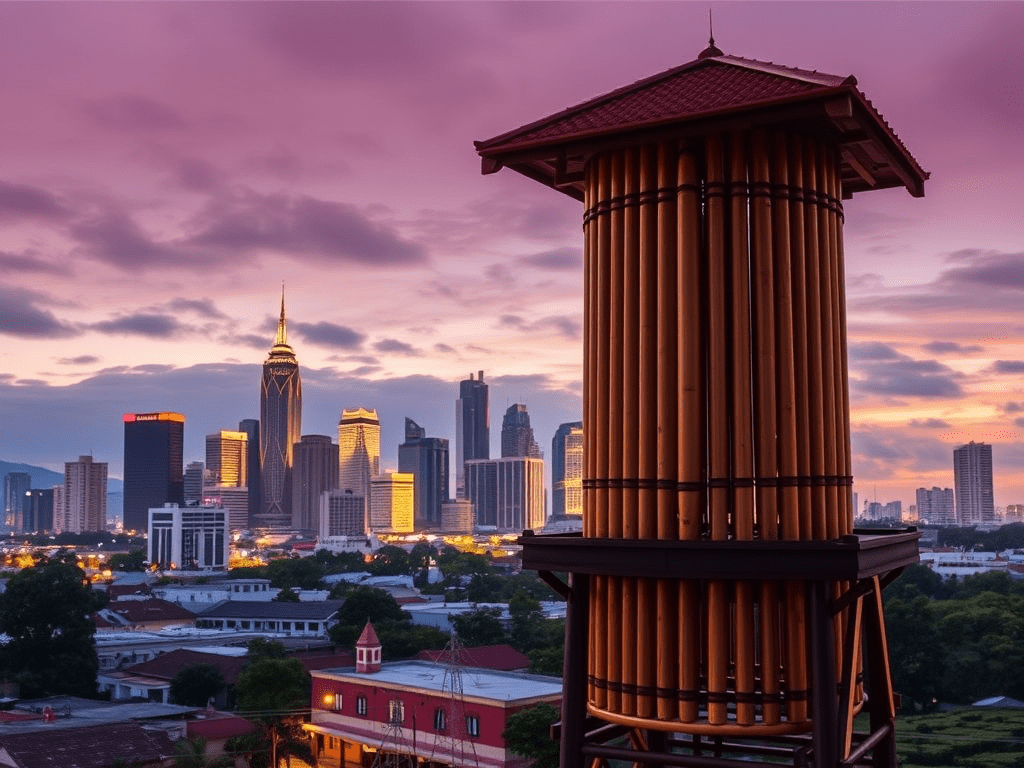
Las Piñas City, historically a coastal fishing settlement famed for its salt beds, fishing grounds, and iconic bamboo organ, has transformed over the decades into a predominantly residential hub with a strong middle-class identity. At only 32.69 km², it is one of Metro Manila’s most compact cities, yet it holds a strategic position at the southern edge of the National Capital Region. This location makes it a physical and economic bridge between Metro Manila and Cavite/CALABARZON — the country’s fastest-growing industrial corridor.
With over half of its land devoted to housing, Las Piñas is long known for its suburban appeal, gated subdivisions, and accessible lifestyle. The city’s transport links — CAVITEX, SLEX, and soon the LRT-1 extension — give it the potential to move people and goods efficiently, provided growth is managed strategically.
However, the city stands at a pivotal moment. Urban density, land scarcity, workforce readiness, and over-reliance on a narrow set of sectors could cap its economic potential. At the same time, the governance shift of 2025 — the first major political transition in more than three decades — presents an unprecedented opening to redefine its role from a commuter city into a high-value economic contributor.
This report synthesizes Las Piñas’ strengths, constraints, opportunities, and policy pathways, combining insights from the 2020–2030 Comprehensive Land Use Plan (CLUP) with additional economic, demographic, and comparative data not currently reflected in official planning.
2. Political Landscape: From Dynasty to Transition
For over 30 years, Las Piñas was under the political stewardship of Cynthia Villar and the Villar family. Their governance style emphasized:
- Large-scale infrastructure and environmental projects (e.g., Sagip Ilog, LPPCHEA wetland preservation)
- Leveraging private-sector capital through real estate and retail development
- Centralized decision-making supported by a strong political machinery
In 2025, Mark Anthony Santos — a three-term city councilor and outspoken Villar critic — defeated Villar in a historic upset. His win reflects:
- Voter fatigue with dynastic politics
- A demand for transparency and accountability in infrastructure and public services
- Appetite for social service expansion (housing, healthcare, education allowances)
This political turnover is not just symbolic — it can recalibrate how Las Piñas engages with national agencies, Metro Manila governance, and private investment.
3. Current Profile and Economic Standing
3.1 Land Use Overview
According to the CLUP:
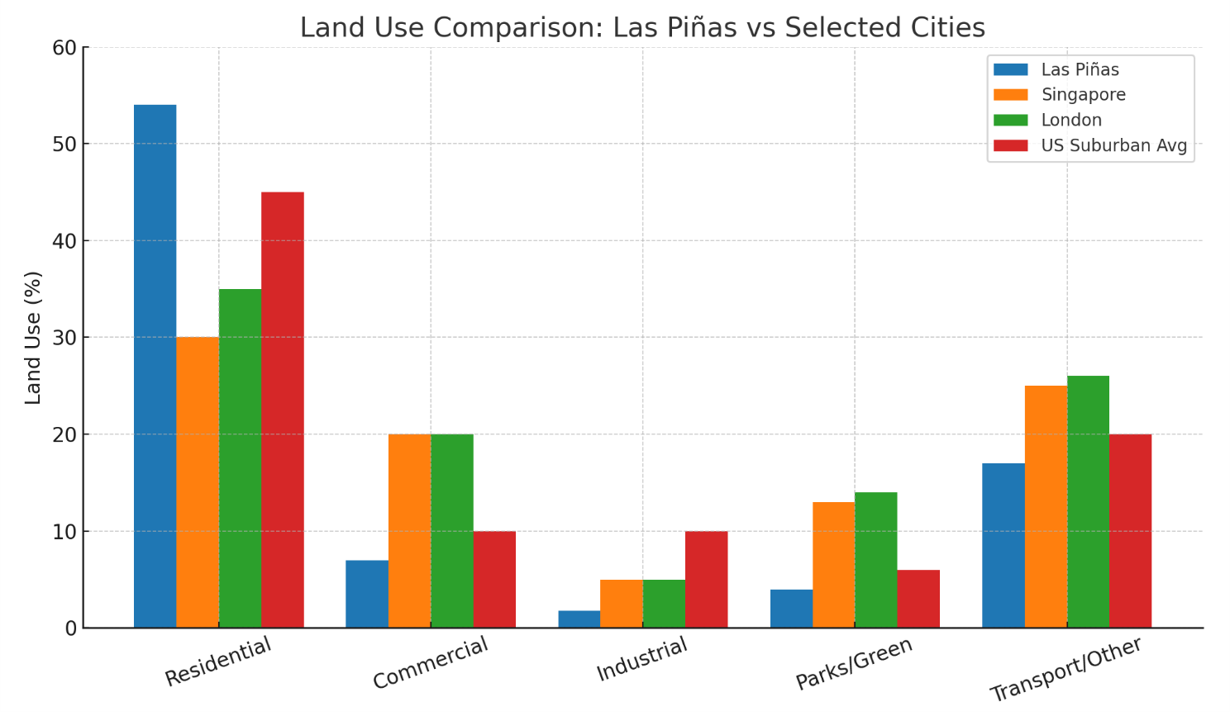
- Residential: 54% (2020) → projected 57% by 2030
- Commercial: 7.3% → projected 20%
- Industrial: 1.75% → projected <1%
- Parks/Green: 4.1% → projected 3.1%
- Other Uses (transport, water bodies, cemeteries, vacant/protected): ~17%
Compared globally:
- Residential share is higher than compact cities (25–35%) and even above suburban norms (40–50%).
- Commercial land is set to match high-performing service cities by 2030—but only if vertical density is achieved.
- Green space is well below the WHO-recommended 9–10 m² per resident.
3.2 Revenue Trends
- Historically dependent on real property taxes and national government transfers (IRA).
- Recent growth in commercial property taxes from malls, retail strips, and mixed-use developments.
- Industrial tax contribution is shrinking, limiting economic diversity.
- Without new high-value sectors, revenue growth risks plateauing as residential zones saturate.
3.3 Demographic Composition
- Population: ~606,000 (2023 est.)
- Diverse origins: While many residents are native-born, a significant share migrated from nearby Cavite, Laguna, Batangas, and other Metro Manila cities, driven by subdivision development in the 1980s–2000s.
- Overseas Filipino Worker (OFW) households are a major economic pillar, bringing remittances but also reinforcing service consumption over local production.
4. Strengths
Strategic Location: Gateway between Metro Manila and CALABARZON, with access to Coastal Road, C5, and the LRT-1 extension.
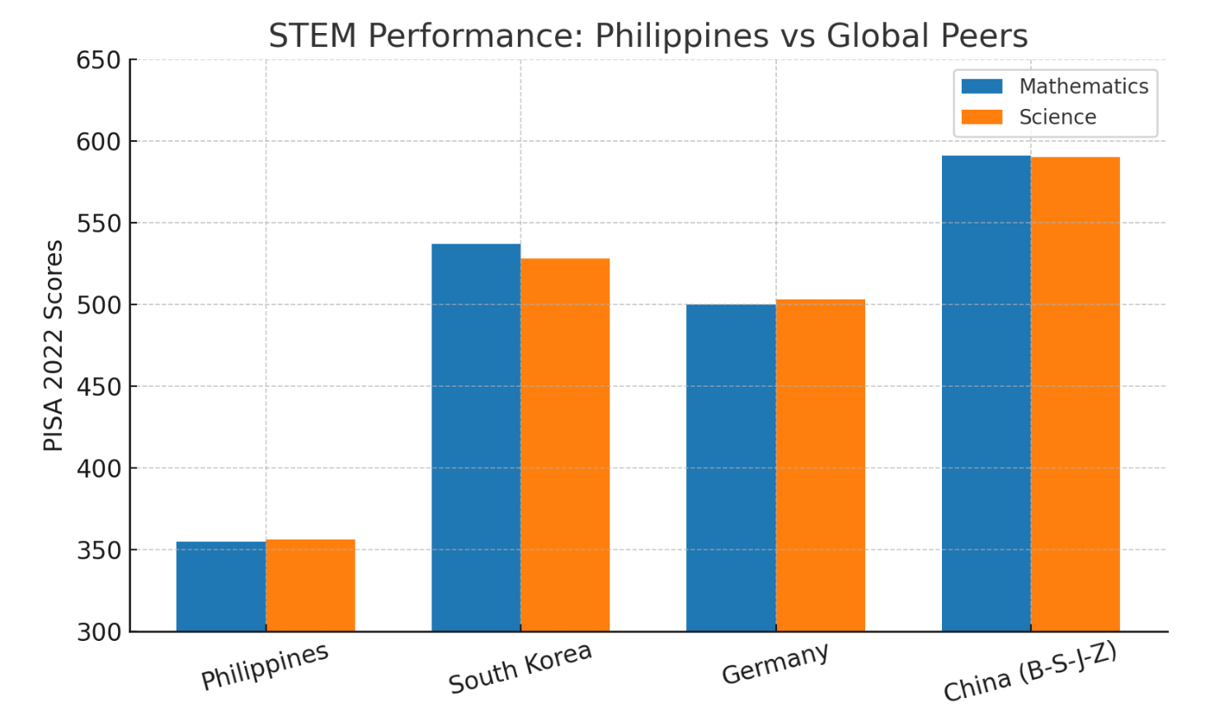
Educated Middle-Class Base: Strong performance in English and social sciences, though STEM scores lag behind East Asian peers (PISA 2022).
Growing Service Sector: Retail, banking, health services, and education anchor much of the local economy.
Cultural & Heritage Assets: Bamboo Organ, salt-making history, LPPCHEA wetlands.
5. Constraints
Land Use Imbalance: High residential share limits economic activity per hectare.
Low Industrial Capacity: Less than 1% industrial land by 2030 restricts diversification.
Skills Gap in STEM: Weak mathematics and science scores compared to South Korea, Germany, and Chinese Taipei.
Environmental Pressures: Limited green space, flood-prone waterways, and urban heat risks.
Revenue Dependence: Overreliance on property taxes from residential areas.
5.1 Residential Dominance Is Unusually High
- Las Piñas: ~54% of land is residential (2020), projected to reach nearly 57% by 2030.
- Global Norm:
- Compact Asian cities (e.g., Singapore, Hong Kong): Residential land share is often 25–35%, due to mixed-use zoning and vertical housing.
- Western urban cores (e.g., London, New York City): Residential is 30–40%, with more mixed-use development in downtown areas.
- Implication: Las Piñas has a high suburban-style footprint relative to its land size, reducing space for commerce, green space, and economic activity per hectare.
5.2 Commercial Share is Growing — But From a Small Base
- Las Piñas: 7.3% (2020) → 20% (2030 projection).
- Global Norm:
- Service-led cities like Singapore, Dubai, or London keep commercial use 15–25%, but much of it is high-density, multi-story, and integrated with transport hubs.
- Implication: The planned jump is ambitious — but success depends on redevelopment and vertical growth, not just re-zoning.
5.3 Industrial Land is Declining Faster Than Average
- Las Piñas: 1.75% → 0.94% by 2030.
- Global Norm:
- Cities in transition (e.g., Seoul, Shenzhen) often reduce industrial zones to 5–10%, but still keep strategic light manufacturing or logistics hubs near transport corridors.
- Implication: Las Piñas may be phasing out industry entirely, which could limit economic diversity and resilience unless replaced by strong logistics or creative industries.
5.4 Public Green Space is Well Below WHO Recommendations
- Las Piñas: 4.1% parks/recreation (2020) → 3.1% (2030).
- WHO Recommendation: 9–10 m² per resident, which for Las Piñas’ ~600,000 people means ~540–600 hectares — triple what it currently has.
- Global Norm:
- Singapore: ~13% public green space
- New York City: ~14%
- Tokyo: ~7–8% (in highly urbanized wards)
- Implication: Shrinking green space could worsen heat island effects, flooding, and livability.
5.5 “Non-productive” Uses (Transport, Utilities, Water, Cemeteries)
- Las Piñas: ~17% (roads, rivers, protected areas, cemeteries, idle land)
- Global Norm:
- Most cities dedicate 20–30% to transport infrastructure alone — but often balance it with underground or elevated multi-use systems.
- Implication: Las Piñas is on the leaner side here — but could re-purpose idle and low-value parcels for mixed-use development.
Summary Table: Las Piñas vs Global Averages
| Category | Las Piñas 2020 | Global Compact City Avg | Global Suburban Avg |
|---|---|---|---|
| Residential | 54% | 25–35% | 40–50% |
| Commercial | 7% | 15–25% | 5–15% |
| Industrial | 1.8% | 5–10% | 5–15% |
| Parks/Green | 4% | 10–15% | 5–10% |
| Transport/Other | 17% | 20–30% | 15–25% |
Key Takeaways for Las Piñas
- Strength: Planned surge in commercial share could align it with service-driven global cities.
- Risk: Residential dominance + shrinking green space could harm long-term livability and climate resilience.
- Opportunity: Idle/vacant lands and underutilized infrastructure corridors can be re-zoned for high-density, mixed-use growth without massive greenfield expansion.
6. Gaps in the Official CLUP
While the CLUP addresses housing, mobility, green parks, disaster risk reduction, and cultural heritage, it does not fully integrate:
- Sector-specific GDP impact projections
- Education and workforce readiness benchmarking
- Revenue diversification strategies
- Creative industry, medical tourism, and high-value niche development
- National trade and service export resilience context
7. Strategic Pathways for Growth
7.1 Economic Diversification
- Knowledge & Creative Industries: BPO hubs, design studios, digital services integrated into mixed-use zones.
- Specialty Light Manufacturing: Food processing, electronics assembly, and urban agriculture clusters in eco-friendly vertical spaces.
- Medical & Wellness Tourism: Capitalize on private hospitals and residential appeal to attract regional patients.
- Elderly Care Industry: Develop assisted living and wellness communities for both domestic and overseas retirees.

7.2 Urban Form and Land Use Reform
- Redevelop aging subdivisions into mixed-use mid-rise developments.
- Convert select idle/vacant lands into commercial and innovation hubs.
- Increase public green space from 4% to at least 9% via pocket parks, rooftop gardens, and LPPCHEA-linked eco corridors.
7.3 Skills and Workforce Development
- Upgrade STEM curriculum in public schools.
- Partner with TESDA and private industry for targeted vocational training in IT, health care, and light manufacturing.
7.4 Infrastructure and Connectivity
- Expand feeder networks to the LRT-1 extension and C5 link.
- Build an intermodal terminal integrating land and potential coastal transport.
- Deploy smart transport systems to reduce congestion and improve last-mile connectivity.
8. Potential GDP Contributions by Sector (2035)
| Sector | Est. GDP Uplift | Rationale |
|---|---|---|
| Knowledge & Creative Industries | ₱10B | High-value jobs, low land footprint |
| Medical & Wellness Tourism | ₱5–8B | Strong private healthcare base |
| Light Manufacturing | ₱3–4B | Eco-friendly, job-intensive |
| Retail & Hospitality | ₱2–3B | Expand from strong existing base |
| Green Economy (urban farming, eco-tourism) | ₱1–2B | Leverages LPPCHEA, local branding |
9. Trade-Offs for Growth
| Constraint | Can Give Way? | Required Action |
|---|---|---|
| Residential dominance | Yes | Zoning reforms, mixed-use infill |
| Low industrial share | Partially | Focus on clean, vertical industries |
| Low green space | Yes | Repurpose idle/vacant land, rooftop greenery |
| Limited skills in STEM | Yes | Intensive education reform, industry partnerships |
10. Conclusion: A Decisive Decade Ahead
Las Piñas stands at a turning point. Its strategic location, middle-class base, and distinct cultural identity give it the foundations to become more than a residential hub — they can serve as a launchpad for economic transformation. Today, the city is wealthier per capita than many Philippine cities, yet structurally fragile if it does not rebalance land use, diversify revenue sources, and upskill its workforce.
The 2025 governance transition, after more than three decades of political continuity, offers a rare and time-sensitive opportunity to reposition Las Piñas from a commuter suburb into a nationally recognized dynamic economic node. The CLUP already sets a base for mobility, housing, and environmental resilience, but our extended analysis adds the economic, educational, and trade dimensions essential for a truly integrated growth plan.
In a city as land-limited and densely populated as Las Piñas, every hectare, every peso of investment, and every year counts. By 2035, decisive, data-driven action could shift Las Piñas into a high-value contributor to national growth — but only if bold choices are made now, while the window remains open.



 Systems Thinking Research & Leadership Development Institute (STRLDi)
Leave a comment