
When you begin to wonder, where today’s persistent problems come from, what have you noticed?
Well, according to this law, they come from yesterday’s solution to the same or a different problem. Yesterday, it had been a great solution to the problem. And in fact, you actually see the solution begin to reverse the problem at first. The key is, ‘at first’. Over time, however, the solution has re-created the problem today.
Let us take a look at an example.
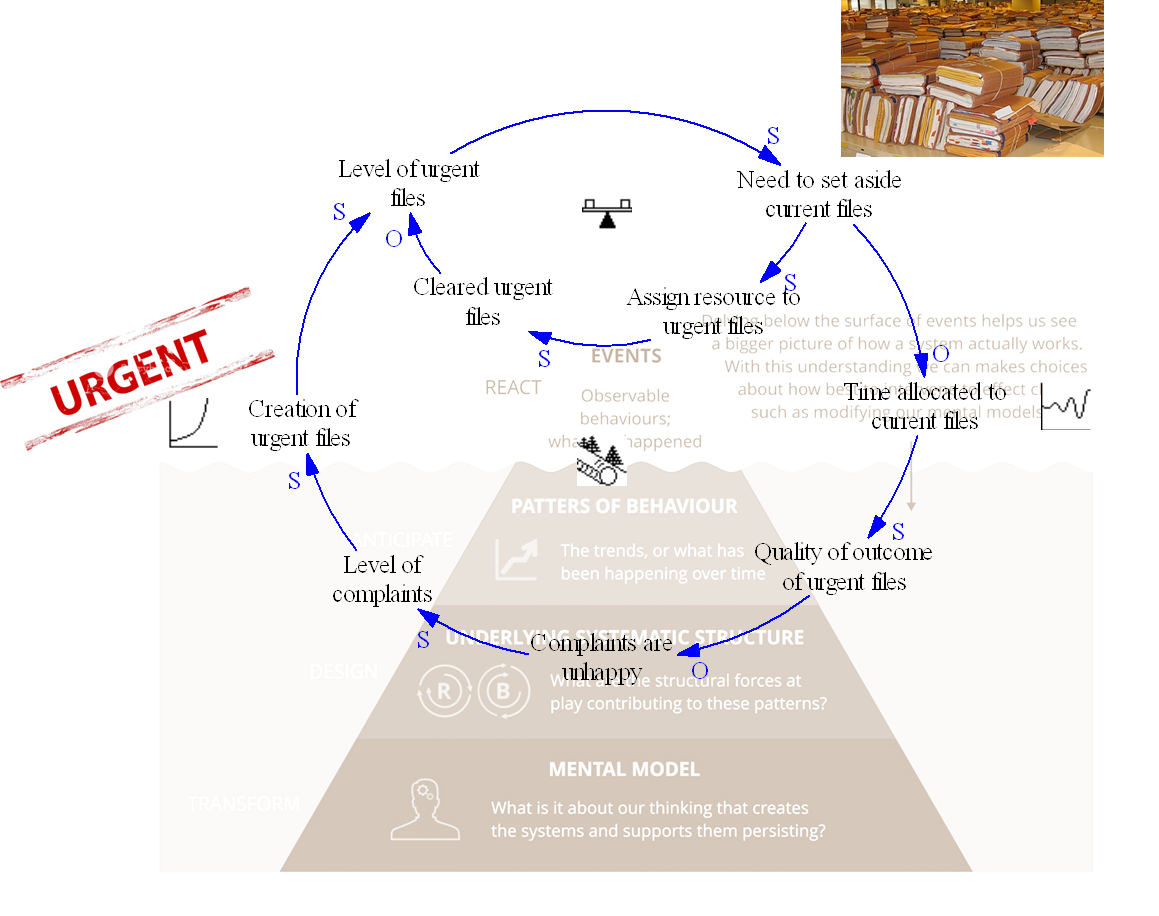
THE STORY OF URGENT FILES

The police investigation superintendent notices the number of files that have remained in backlog and therefore unsolved in his department, has grown with time. He is seeking to be promoted this year and does not wish to see this matter become an issue that gets in the way of his goal. He calls a meeting and orders the setup of a task team to act on and reduce the pile of backlog files immediately. However, to resolve the backlog cases, the task team resorts to putting their ongoing active investigation files on hold, so as to use the time to clear the backlog files on an urgent basis.

A few weeks later, with the men hard at work, the pile of backlog cases began to reduce. Everyone is happy and rejoices. A few days on, the complainants of the current active files notice their files are placed on the backlog instead, and begin to make inquiries on the investigation status of their files. They are unhappy with the response that the office shall get back to them shortly. They decide to take matters into their own hands and raise their concerns to the police superintendent, and state categorically that they want to see their files treated with a matter of urgency. If they do not see a change in prioritizing their files, they will take the matter up with their supervisor. He now fears for his promotion prospects and accepts the new files marks them as ‘URGENT’ to his investigators and places them in his out-tray.
The moral of the story: The more we set aside current files to work on urgent files (yesterday’s solution), the more urgent files we create (today’s problem). The workload doubles as each file has increased the number of times it goes on to the production line.
Can you see the vicious circle of causality at play?
THE POPULATION CONTROL STORY
Here’s another example of a young country learning to understand the impact of controlling its population except it is doing so, from its future.
A young country, like Singapore in the 1960s, was struggling to stand up on its feet. It had just gained independence from its colonial masters and also separated recently from its neighbor, Malaya with whom it had shared its people, history, and resources from time back.
- It lacked its own natural resources including water and sufficient farmland (it relies on its raw materials and food sources in Malaya).
- Although it now has a land size of 722 sq km it has a density of 7,900 persons per sq km with a population of 5.6 million to 2.3 million Botswana (this compares to 4 persons per sq km for Botswana on a land size of 600,370 sq km or 800+ times the land size of Singapore).
- Its indigenous races, the Chinese, Malays, and Indians, are primarily rooted in agrarian societies and so their cultures tend to promote large families.
- This was the setting against which Singapore intended to industrialize to absorb a burgeoning population on a tiny island and the highly strategic position it holds on the international waterways with its shipping port.
Back then, it soon realized that if it did not do enough to reign in the population growth, it would not have enough resources (schools, hospitals, housing, etc.) to provide for itself. And so, very early on in its newfound independence, it passed a law that all families would bear no more than two children.
Over time, the population listened and obeyed. With each generation every decade, they began to produce fewer offspring from five to three and two and eventually one and sometimes none :
- The birth rate dropped from 5.45 births per woman in 1960 to 1.20 in 2016). With rising costs of living and little personal time left, often led families to delay procreation or individuals to choose not to marry at all.
- With one child to replace every two adults, that would mean Singapore could not essentially replace itself. And so while its economy began to expand and now the private sector was investing in its infrastructure, it was finding it hard to fill the positions. It had a new problem on its hands.
And so, to correct the new problem, Singapore had to learn quickly how to open its door wide to foreigners or face failure.
Today, a large percentage of its population are non-residents; of its total population of 5.47 million in 2014, 3.87 million were residents (citizens plus permanent residents), and 1.6 million were non-residents. In June 2016, Singapore’s population hit 5.61 million in June 2016. The not-so-good news? The number of foreigners (non-residents + permanent residents) now make up a whopping 64 percent of the population.

Singapore’s general economic indicators
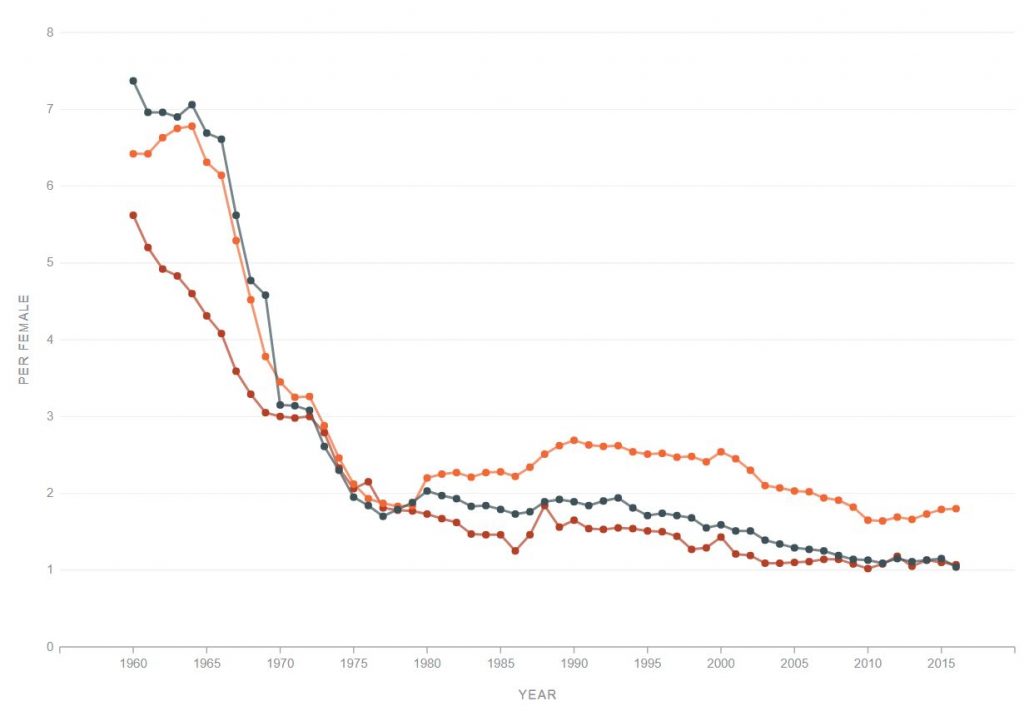
Ratio of male Chinese (red), Malay (orange) and Indian (blue) to females, 1960-2016 A high ratio suggests an influx of male migrants.
[Note: We shall present here data that shows the proportion of contribution to the population by citizens and residents when it becomes available.]
LEARNINGS: KEY QUESTIONS
- So, where did today’s problems come from? Yesterday’s solution. Right!
- How long ago was yesterday’s solution? Sixty years ago. Right!
- Would that mean, that we would need to wait 60 years from today’s solutions to learn the consequence of tomorrow’s problems? What could have happened to see sooner that this was coming?
To do this, let us put two figures side by side. One where the population was controlled and the other that was not.
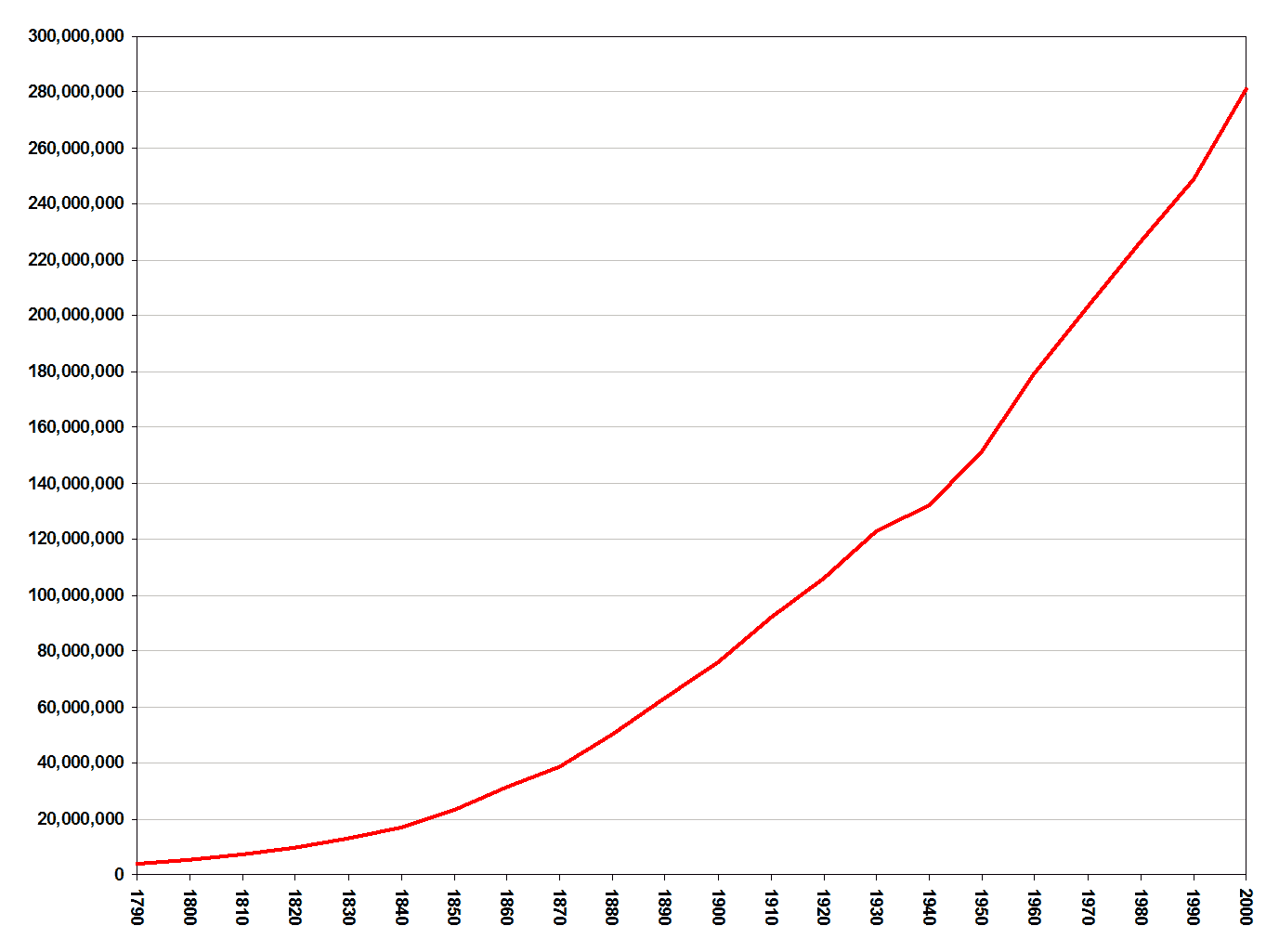
The population of United States 1790-2000
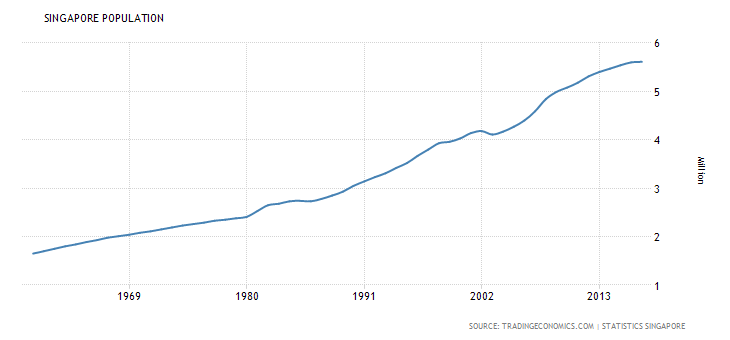
The population of Singapore (after increasing the proportion of foreigners to 64%)1960-2016
What do you notice?
What is the inherent nature of behavior over time of an uncontrolled population? Did you say it behaves more like a reinforcing loop? What does the behavior of Singapore’s population look like instead?
Well, right now, it is hard to tell. But should we remove the resident and naturalized citizens from the population graph, it is possible that we may be looking at a negative reinforcing loop.
All natural systems are reinforcing loops. They either reinforce positively or negatively. Human populations are natural systems. When left uncontrolled, it reinforces positively just as in the behavior of the population of the US. However, when we attempt to control what was essentially a reinforcing loop, it does not steady and behave consistently with a balancing (or goal-seeking) loop, but instead, begins to reinforce negatively. The causal structure either reinforces positively or negatively.
When we understand this salient aspect of systems thinking, it is possible then, that we can predict the behaviour of any decisions we make today and their impact in the future. This is key.
Knowing this now, what could we have done differently?
Did you say, we would take the knowledge of the systemic structures and the current data to the population masses and let them decide? You have got it right!
Should the population understand what is a reinforcing loop and its behaviour over time, it becomes now better placed to know what it needs to do (remember populations create population) and to monitor the changes more carefully, even so by itself. Now, what could have been more democratic than that?!
All that the leader would have to do is to make the data and choices clear for all to see. Over time, we create a population that can learn to think and act together (rather than cast their votes, silently).
It now leaves us to conclude, that if today’s problem comes from yesterday’s solution, then, it really goes without saying that if we choose not to watch the systemic nature of the solutions we make today, then today’s solutions could become tomorrow’s problems. Yesterday’s solution creates today’s problems. Today’s solution creates tomorrow’s. Often, it is like the structure of the systemic interrelations that leads us to find solutions that feed the persistent nature of these problems.
It is no one person’s fault. See Law #11: There is no blame. It is everyone’s fault for not seeing together how we are a part of the interrelations that exist and therefore letting these structures lead us into trapping us into further problems.
Next –> Law #2
 Systems Thinking Research & Leadership Development Institute (STRLDi)
You must be logged in to post a comment.