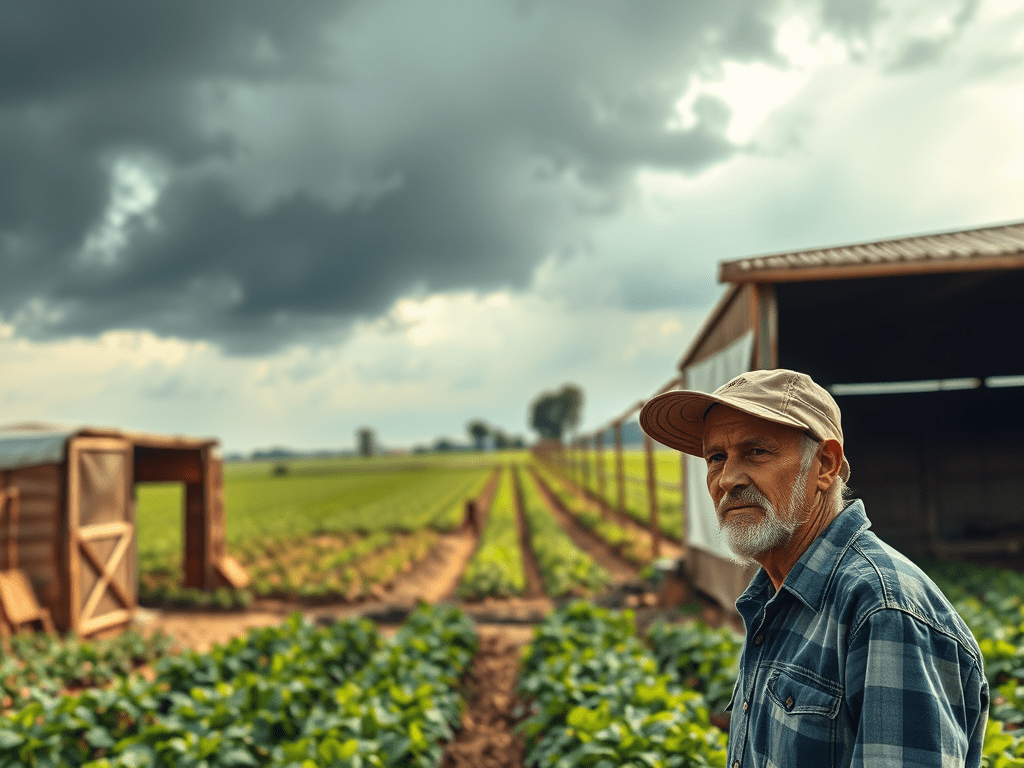
There is an old parable titled “I Can Sleep When the Wind Blows.”
I Can Sleep When the Wind Blows | Shayne M. Bowen | 2018
A farmer hires a young hand. Each night, no matter the weather, the young man goes to bed early. When a storm finally breaks, the farmer panics. He runs to check the fields. However, he discovers that the barn doors are fastened. The tools are secured. The animals are sheltered. The hay is tied down. Everything had been prepared. The young man could sleep when the wind blew, because his work was already in order.
Budgets without backbone
Currently, I observe the following trends in the country. All governments, past and present, have focused mainly on budgeting and disbursing the funds they receive. The machinery is geared to release money and “create a conducive environment.” It monitors. But it does this without actually planning the industry itself.
That is a shame. Because when we avoid planning the industry, we trap ourselves in an endless cycle:
- cash allocations that don’t yield repayment,
- borrowers who appear to build assets with money that does not belong to them,
- and a country that thickens its skin the next time it seeks funding — all without seeing real economic growth.
There is also an unspoken hope that we will be let off the hook because “we are Africans.” But finance does not forgive weak structures.
Dividing what should be united
Each cycle, allocations are trumpeted to youth, women, and farmers. But in reality, these three are not separate categories — they are a family. Women and youth are embedded in family farms. To slice them into compartments for the sake of budgeting is not only wasteful, it is divisive.
True industry planning does not start with who gets the allocation. It starts with building the backbone that ensures profitability for all: demand mapping, planting calendars, logistics, markets, and reinvestment. Once this spine is in place, the benefits naturally flow to every farmer — whether woman, youth, or elder.
Why the backbone is ignored
The deeper reason this backbone is overlooked is the dichotomy we live with as a nation. We underplay the role of STEM in our economy and agriculture. Yet agriculture is one of the industries that most demands a STEM-disciplined approach. This ranges from governance structures down to the farmer’s choice of seed.
When land and GDP are tended by hands guided by STEM discipline, they produce predictability, scaling, and growth. When managed without it, results fluctuate with the weather, pests, and luck.
One hectare, two futures
To make this real: take two farmers, each with 1 hectare.
- The STEM-hardwired farmer runs soil tests and balances water precisely. She selects the right seed for climate and disease. She also manages pests with foresight. Over five years, her profits grow steadily from BWP 80,000 to over 100,000.
- The non-STEM farmer plants by habit and intuition. Some seasons bring decent returns, others collapse under shocks. Over the same period, his profits swing wildly, sometimes as low as BWP 5,000.
One farmer can reinvest and scale. The other cannot.
STEM as the Backbone
Agriculture is not only about soil and seed — it is about systems, and systems require STEM discipline. From governance down to the individual farmer, STEM makes the difference between sustained growth and endless frustration.
On the farm — with STEM
- Seed selection: Matching varieties to soil type, climate, and disease resistance using agronomic trials and data.
- Water management: Irrigation calibrated to evapotranspiration rates, soil moisture sensors, and seasonal rainfall models.
- Fertilisation: Nutrient application based on soil chemistry analysis, preventing both waste and depletion.
- Pest management: Integrated pest management (IPM) using monitoring thresholds and biological controls rather than reacting late with chemicals.
- Scaling: Precision data provides confidence to expand from 1 ha to 2, then 10 — with predictable margins.
On the farm — without STEM
- Seeds chosen by habit or availability, vulnerable to climate shifts.
- Irrigation by “eye” — too much or too little water.
- Fertiliser applied reactively, causing soil exhaustion.
- Pests noticed too late, leading to crop loss or costly sprays.
- Scaling is a gamble; banks are hesitant to lend.
The result? Inconsistent yields, poor profitability, and farmers dropping out of horticulture.
In the system — with STEM
- Data pipelines: Retailers share weekly SKU-level demand, analysed and published as crop calendars.
- Forecasting: National dashboards project shortfalls or surpluses, triggering clear import or storage policies.
- Logistics design: Cold chain hubs placed using flow models of supply vs. demand, not guesswork.
- Finance: Lenders and insurers trust the system because data reduces risk.
In the system — without STEM
- Ministries working in silos — Agriculture with farmers, Trade with retailers, no shared demand–supply map.
- Imports opened or closed arbitrarily, undercutting local farmers.
- Collection centres built as afterthoughts, often underused because produce doesn’t match demand.
- Credit extended, but repayment fails because profitability was never secured.
The absence of STEM discipline is what gets in the way of building the coordination systems horticulture requires. Without it, money flows — but growth stalls.
👉 This section shows concretely: STEM is not just a “nice-to-have” in farming. It is the backbone of both productivity and coordination.
Scaling to the nation
Now imagine horticulture taking 30% of Botswana’s crop land (≈3 million ha), with STEM adoption rising over time.
| Year | STEM Area (ha) | Non-STEM Area (ha) | STEM Profit (BWP Bn) | Non-STEM Profit (BWP Bn) | Total Profit (BWP Bn) |
|---|---|---|---|---|---|
| 3 | 600,000 | 2,400,000 | 54.0 | 72.0 | 126.0 |
| 5 | 1,200,000 | 1,800,000 | 108.0 | 54.0 | 162.0 |
| 10 | 1,800,000 | 1,200,000 | 162.0 | 36.0 | 198.0 |
| 20 | 2,400,000 | 600,000 | 216.0 | 18.0 | 234.0 |
With a STEM backbone, national profits rise steadily and reinvestment becomes possible. Without it, volatility, waste, and default persist.
What leadership requires
The leader who takes this on will not just fix horticulture. They will demonstrate that Botswana can move from funding to building industries that plan and re-fund themselves.
That leader will be remembered for building the industry spine. It was the system that allowed farmers, families, and the nation to reinvest. It let them scale and finally sleep when the wind blows.
Closing thought
Botswana does not lack hardworking farmers. It lacks the discipline of coordination and STEM-driven planning that secures the barns before the storm. If we build that spine, we can turn volatility into predictability, allocations into industries, and families into investors.
Then, and only then, will we all be able to say:
“I can sleep when the wind blows.”
 Systems Thinking Research & Leadership Development Institute (STRLDi)
Leave a comment