“Why should we worry about problems we do not have? We’re growing tremendously. (A little later), “Sure there are some problems, but all we have to do is go back to what was working before.” Still later. “The harder we run, the more we stay in the same place.”
EVENT
WHAT THE STRUCTURE LOOKS LIKE AT A POINT IN TIME (AS AN EVENT)
Whatever we try to do, we are not getting the success we used to get. Somebody is not doing their job well. It feels like a pressure cooker here.
The same things that got us success in the past are not helping us to get as much success as before and seem to be making things worse!
THE STORY OF UNANTICIPATED CONSTRAINTS
PATTERN
A MANAGEMENT STORY ILLUSTRATING THE BEHAVIOR OF THE STRUCTURE PLAYING OUT OVER TIME (BOT / VIDEO)
“Marketing and Service Department” / “Volunteers and Regulars” story
- Sales manager implements successful sales tactics to increase sales of computers
- However, as sales increase, the technicians are unable to handle the increase in computers sent for servicing and repairs
- The poor after-sales service affects the company’s reputation and sales drop.
BEHAVIOUR OF THE GRAPH (PATTERN) OVER TIME

STRUCTURE
DESCRIPTION OF THE ARCHETYPE
Success or growth is leveling off or declining.
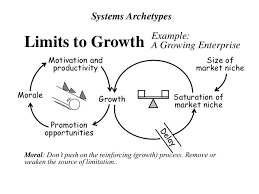
The more effort we put in, the greater the result we get. Therefore we put in more effort that got us the results. However, the same effort we put in creates a limit somewhere else in the system. Over time this creates a limiting action that reverses the growth of the result. This continues to erode the results. At this point, the limit (and the organization) disappears by itself.
When things slow down after the initial dizzying heights of glory.
This suggests that the system has hit a bottleneck that is hidden. It is not easily visible.
If you look at the structure of the archetype carefully, we see that it starts with a circle reinforcing in a positive direction (clockwise on your left-most side of the archetype. Yes? And then as that circle sets into motion, we see another circle running off right next to it. Except it is turning in the opposite direction. It is a pictorial representation but I like this form of presentation as it allows us to imagine a metaphor of a bicycle with wheels turning in opposite directions. Eventually, the bicycle will grind to a halt. That is the fate (destiny) of this structure.
The purpose of this archetype is to find the bottlenecks that are grinding the structure to a halt that may be lying within the system. It is usually the part of the structure that is the least obvious to us. Here’s an example to illustrate this.
Let’s imagine that we have just designed and produced a new model of laptop. It is an excellent design and we think to ourselves that surely we find ways to take it to the market, and people will buy it. So, to make that happen, we set up a team, a team of marketing agents whose role is to take the product to the market and interest customers in purchasing the product.

MENTAL MODEL
OUTLOOK THAT CAUSES THE STRUCTURE TO PERSIST DESPITE OUR EFFORTS TO SOLVE THEM / RESISTS PROBLEM-SOLVING:
““We’ll get bigger and better by continuing to do more of what we are doing now.”
FEAR OF FAILURE. LEARNING: LET IT GO SO AS NOT TO LET THE FEAR AFFECT THE WAY YOU SHAPE YOUR OUTLOOK, PERSPECTIVES AND DECISION-MAKING.
MAKING A SYSTEMIC INTERVENTION
TREATING THE STRUCTURE
BREAKING ORGANISATIONAL GRIDLOCK
PLANNING
If we don’t plan for limits we are planning for failure. By mapping out the growth engines and potential danger points in advance, we can anticipate future problems and eliminate them.
Intervention:
- The archetype is most helpful when it is used ahead of any problems, to see how the cumulative effects of continued success might lead to future problems
- Use the archetypes to explore questions such as “What kinds of pressures are building up in the organization as a result of growth?”
- Look for ways to relieve pressures or remove limits before success blows over – may need to consider slowing down the growth to hive resources long enough to overcome the limits
What it looks like if the system was working well:
- “We can overcome limits by planning for them.”
- We identify, evaluate, and plan for limits.
- We discover shared visions that resolve the Success to the Successful, Escalation, Shiting the Burden, Fixes that Backfire and Drifting Goals archetypes and gets us out of the stuckness together.

 Systems Thinking Research & Leadership Development Institute (STRLDi)
You must be logged in to post a comment.